


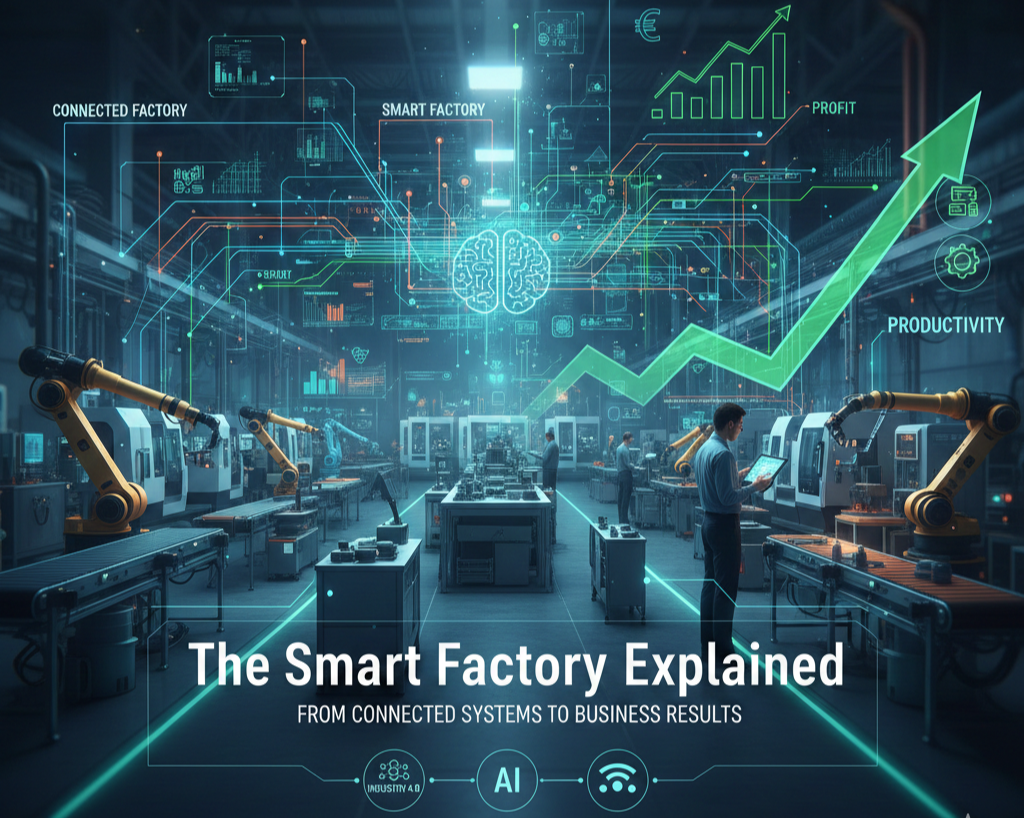
Manufacturing leaders hear the term smart factory everywhere—but its meaning is often blurred by buzzwords like Industry 4.0, AI, and IoT. Is a smart factory simply a highly automated plant? Is it just about connected machines? Or is it something more strategic?
For business decision-makers, understanding what a smart factory really is—and how it differs from a connected factory—matters because it directly impacts productivity, quality, cost control, and long-term competitiveness.
This article explains what a smart factory is in clear business terms, how it works, and real-world smart factory examples that show why manufacturers are adopting this approach.
Further reading: Smart Manufacturing: Market Outlook 2026
What Is a Smart Factory?

A smart factory is a manufacturing environment where data, systems, machines, and people are continuously connected and optimized to improve business outcomes.
Unlike traditional factories that rely on fixed processes and reactive decision-making, smart factories use real-time data and intelligent systems to adapt operations automatically or semi-automatically.
From a business perspective, a smart factory focuses on:
- Higher operational efficiency
- Improved product quality
- Faster response to change
- Better return on automation investments
Automation alone does not make a factory “smart.” Intelligence, integration, and adaptability do.
A Business Definition
A smart factory is a data-driven manufacturing operation that uses connected systems and intelligent technologies to monitor, analyze, and optimize production in real time.
The goal is not technology for its own sake—it is better decisions, made faster, across the entire operation.
Key Characteristics
While implementations vary, most smart factories share these characteristics:
- Real-time visibility into production, quality, energy use, and equipment health
- Integrated systems, where machines, testing equipment, software platforms, and people work together
- Data-driven decision-making, supported by analytics and AI
- Continuous optimization, rather than fixed, static processes
Scalability, allowing manufacturers to expand or adjust without major disruption
Smart vs. Connected
One of the most common points of confusion is the difference between a connected factory and a smart factory.
What Is a Connected Factory?
A connected factory focuses on connectivity. Machines, sensors, and systems are networked so data can be collected and visualized.
This typically enables:
- Dashboards and monitoring
- Basic alerts and reporting
- Improved visibility into operations
However, in a connected factory, humans still do most of the analysis and decision-making manually.
Going Beyond Connectivity
A smart factory builds on connectivity but goes further by turning data into action.
Instead of simply showing information:
- Systems analyze patterns automatically
- Problems are identified earlier.
- Adjustments can be triggered without manual intervention.
In short:
- Connected factory = visibility
- Smart factory = visibility + intelligence + optimization
Core Technologies Behind a Smart Factory

Smart factories are enabled by multiple technologies working together. From a business standpoint, what matters is not the technology itself, but the capabilities it provides.
Common building blocks include:
- Industrial IoT and sensors for real-time data capture
- Manufacturing Execution Systems (MES) for operational coordination
- Data analytics and AI for insights and predictions
- Digital twins and simulation for planning and optimization
- Testing, measurement, and monitoring systems for quality and compliance
- Edge and cloud computing for scalable data processing
Not every smart factory uses all of these—but most use a combination aligned with their business priorities.
Further reading: How Digital Twins Optimize Production, Quality, and Uptime
Examples in Manufacturing
The best way to understand smart factories is to see how manufacturers use them in practice.
Reducing Downtime with Predictive Maintenance
In a traditional factory, equipment is serviced on fixed schedules or after failures occur.
In a smart factory:
- Sensors monitor vibration, temperature, and electrical behavior
- Data analytics detect early signs of failure.
- Maintenance is scheduled before breakdowns happen.
Business impact:
- Higher uptime
- Lower maintenance costs
- Fewer production disruptions
Improving Quality Through Automated Testing
Quality issues are expensive, causing scrap, rework, and warranty claims.
Smart factories integrate:
- Automated testing and measurement systems
- Real-time quality data
- Immediate feedback to production processes
When deviations occur, adjustments are made quickly, not days later.
Business impact:
- More consistent quality
- Faster root-cause analysis
- Reduced waste and recalls
Flexible Production for Changing Demand
Demand volatility is a growing challenge.
Smart factories use:
- Production data and digital models
- Modular automation systems
- Rapid changeover capabilities
This allows manufacturers to shift product mix or volume with minimal downtime.
Business impact:
- Shorter lead times
- Lower inventory risk
- Greater responsiveness to customers
Energy Optimization and Sustainability
Energy is a major cost driver in manufacturing.
Smart factories monitor:
- Energy usage by line, machine, or process
- Power quality and efficiency
- Peaks and inefficiencies in real time
This enables optimization without compromising output.
Business impact:
- Lower operating costs
- Easier compliance with regulations
- Progress toward sustainability goals
Further reading: The New Era of Practical Sustainability in Manufacturing
Business Benefits of a Smart Factory

When implemented with clear objectives, smart factories deliver measurable benefits:
- Increased productivity through optimized processes
- Improved quality and consistency
- Faster, better decision-making
- Greater resilience against supply chain and labor disruptions
- Higher ROI from automation and digital investments
Is a Smart Factory Only for Large Manufacturers?
No. In fact, mid-size manufacturers often adopt concepts faster than large enterprises.
Why?
- Less legacy complexity
- More focused descision-making
- Easier pilot projects and scaling
Smart factories do not require a “big bang” transformation. Many companies start small—focusing on one production line, one pain point, or one system—and expand over time.
How to Start the Smart Factory Journey

A practical approach includes:
- Identify business pain points: Downtime, quality issues, energy costs, or lack of visibility
- Connect critical systems and data sources: Start where impact is highest
- Add intelligence incrementally: Analytics, automation, and optimization over time
- Measure ROI and scale: Use results to justify expansion
Common Misconceptions About Smart Factories
- “A smart factory requires full automation.”
It does not—many combine automation with human expertise.
- “Smart factories replace workers.”
In reality, they support workers with better data and tools.
- “It’s just about robots.”
Robotics may be part of the solution, but intelligence and integration matter more.

A smart factory is not a single technology or product—it is a business strategy for modern manufacturing.
By moving beyond simple connectivity and embracing intelligent, data-driven operations, manufacturers can improve efficiency, quality, and resilience in a rapidly changing market.
Understanding the difference between a connected factory and a smart factory is the first step toward making smarter investment decisions—and building a more competitive operation for the future.
Further reading: Why Japan’s Manufacturing DNA Matters in the Global Industry 4.0 Race


