


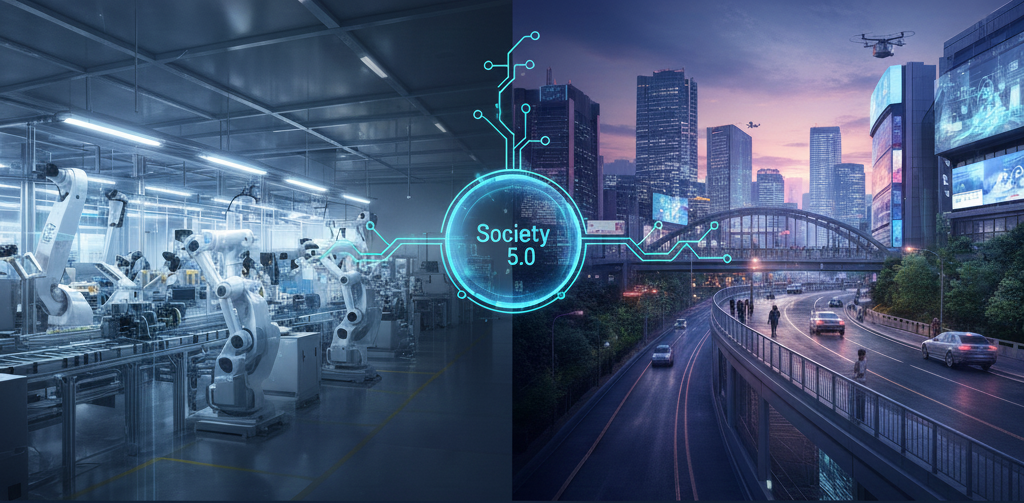
Japan’s concept of Society 5.0 has been widely referenced in government papers and conference keynotes, but its real significance lies not in the slogan itself—it lies in how companies are implementing it. Unlike many national digital visions, Society 5.0 is deeply manufacturing-driven. it positions advanced industry as the engine of a human-centered, technologically integrated society that blends cyberspace and physical space.
For global readers, Society 5.0 matters because Japan is showing how national policy and industrial execution can work together to build smarter factories, infrastructure, and communities. The idea is no longer abstract: it is visible in production lines, in connected city districts, and in emerging mobility ecosystems.
Policy Foundations: How Japan Designed Society 5.0

A National Vision for a Super-Smart Society
The Japanese government introduced Society 5.0 as a response to structural challenges: labor shortages, demographic aging, energy constraints, and fierce global competition. The Cabinet Office defines it as a super-smart society where data, AI, and advanced automation enhance human abilities and remove friction from daily life and industrial activity.
The policy framework aligns closely with Japan’s broader DX (digital transformation) push and long-term sustainability strategy. Rather than treating digitalization as a standalone goal, Society 5.0 connects it to economic revitalization, social well-being, and environmental responsibility.
Policy and Industry Moving in the Same Direction
Japan’s strength has always been its coordination of industrial policy with private-sector capability. Agencies such as METI (Ministry of Economy, Trade and Industry) and NEDO (New Energy and Industrial Technology Development Organization) play a central role by funding smart factory demonstrations, supporting regulatory sandboxes for new technologies, and offering incentives for carbon-neutral manufacturing.
Local governments—from Aichi and Fukuoka—also push adoption through ecosystem-building, cluster initiatives, and SME digitalization programs. The result is a landscape where policy goals and corporate innovation tend to reinforce each other.
Smart Factories: Society 5.0 on the Production Floor
What Society 5.0 Means in Industrial Terms
For manufacturers, Society 5.0 isn’t about abstract technological progress—it’s about using digital tools to build resilient, adaptive, and human-supportive factories. The focus is shifting from pure efficiency to flexibility, sustainability, and continuous improvement supported by data.
Real Examples From Leading Manufacturers
Toyota applies Society 5.0 principles through data-rich, connected plants that improve kaizen with real-time insights. Autonomous logistics vehicles, digital twins, and AI-driven quality management systems enhance both productivity and worker safety.
Fanuc demonstrates the “super-smart” factory at scale with its cloud-connected CNC systems and AI-driven predictive maintenance. Its robots continuously report operational data to a secure cloud platform used to optimize uptime across global facilities.
Hitachi integrates OT and IT through its Lumada platform, enabling factories to run self-diagnosing equipment, optimize energy use, and orchestrate supply chains via connected digital systems.
Japanese SMEs—long considered the backbone of manufacturing—are also adopting Society 5.0 tools. Lightweight IoT sensors, remote machine diagnostics, and AR-based technician guidance lower the barriers to participation, making digital transformation accessible even for small factories.
Further reading: Smart Manufacturing: Market Outlook 2026
Beyond the Factory: Smart Cities and Mobility Ecosystems

Society 5.0 is just as visible outside factory walls. Smart cities across Japan function as living testbeds for connected infrastructure, energy management, and mobility systems.
Smart City Implementations
Projects like Fujisawa Sustainable Smart Town and Kashiwa-no-ha Smart City integrate renewable energy systems, real-time environmental monitoring, shared mobility, and data platforms that connect homes, businesses, and municipal services. They represent Society 5.0 scaled to the community level.
Mobility and Logistics Revolution
Japan’s mobility innovation aligns tightly with its manufacturing strengths.
- Autonomous shuttle pilots by ZMP, Nissan, and Toyota’s e-Palette showcase human-supportive urban transport.
- Logistics hubs increasingly use automated mobile robots (AMRs), AI-driven routing, and warehouse digital twins—developments that feed directly back into smart factory automation.
These initiatives demonstrate how Society 5.0 blends industrial, urban, and mobility systems into cohesive digital ecosystems.
Further reading: Smart Factories 4.0: How AI and IoT Are Rewiring Global Manufacturing
Sustainability and Circular Production
Sustainability sits at the center of Society 5.0, shaping how factories consume energy, manage materials, and interact with broader resource networks.
Panasonic operates energy-positive factories using integrated solar, hydrogen systems, and AI-driven power optimization.
Mitsubishi Electric deploys CO₂-reduction manufacturing cells that monitor and adjust equipment energy loads in real time.
Circular economy initiatives—remanufacturing of industrial equipment, robotics refurbishing, and digital material tracking—are expanding across automotive and electronics supply chains. These projects show how Society 5.0 integrates environmental goals directly into manufacturing processes rather than treating them as add-ons.
Further reading: The New Era of Practical Sustainability in Manufacturing
Workforce Transformation: Human-Centric Automation

One distinguishing feature of Japan’s approach is its commitment to augmenting people rather than replacing them. Society 5.0’s vision reflects Japan’s cultural and industrial philosophy: technology should elevate workers, reduce physical strain, and transfer skills—not simply cut labor.
Human-robot collaboration, AR/VR training systems, and digital skills programs are now standard at major manufacturers. Worker well-being and knowledge retention are treated as pillars of competitiveness.
Challenges: Where Society 5.0 Still Faces Barriers
Even with significant progress, implementation is uneven.
- Many SMEs struggle with legacy equipment and limited digital talent.
- Corporate risk aversion slows deployment of bold new systems.
- Data standardization across industries remains a work in progress.
- Global competition for AI and cybersecurity talent puts pressure on companies.
These challenges highlight that Society 5.0 is not fully realized yet—it is an evolving national experiment.
Global Implications: Lessons for Industry Worldwide
Countries exploring industrial transformations can draw key lessons from Japan’s Society 5.0 model:
- Policy alignment matters: industrial strategy, digital policy, and environmental regulation work better when coordinated.
- Incremental innovation works: Japan’s ability to refine long-term systems offers an alternative to disruption-focused models.
- Human-centric digitalization is viable: automation can support an aging workforce rather than displace it.
- Manufacturing culture still matters: craftsmanship, quality, and reliability remain competitive advantages in a data-driven world.
Society 5.0 shows how a nation can pursue digital transformation with social stability and long-term continuity in mind.
Further reading: Predictive Maintenance: The Data-Driven Solution to Industrial Downtime
Society 5.0 Is Already Here

Society 5.0 is no longer just a concept in government documents—it is taking shape in Japanese factories, supply chains, smart cities, and mobility platforms. While Japan still faces digitalization challenges, its coordinated approach, manufacturing culture, and commitment to human-centric automation offer a model with global relevance.
As the world looks for pathways to build resilient, sustainable, and adaptive industrial systems, Japan’s Society 5.0 provides a compelling—and increasingly practical—blueprint for the future.
Further reading: Why Japan’s Manufacturing DNA Matters in the Global Industry 4.0 Race


