


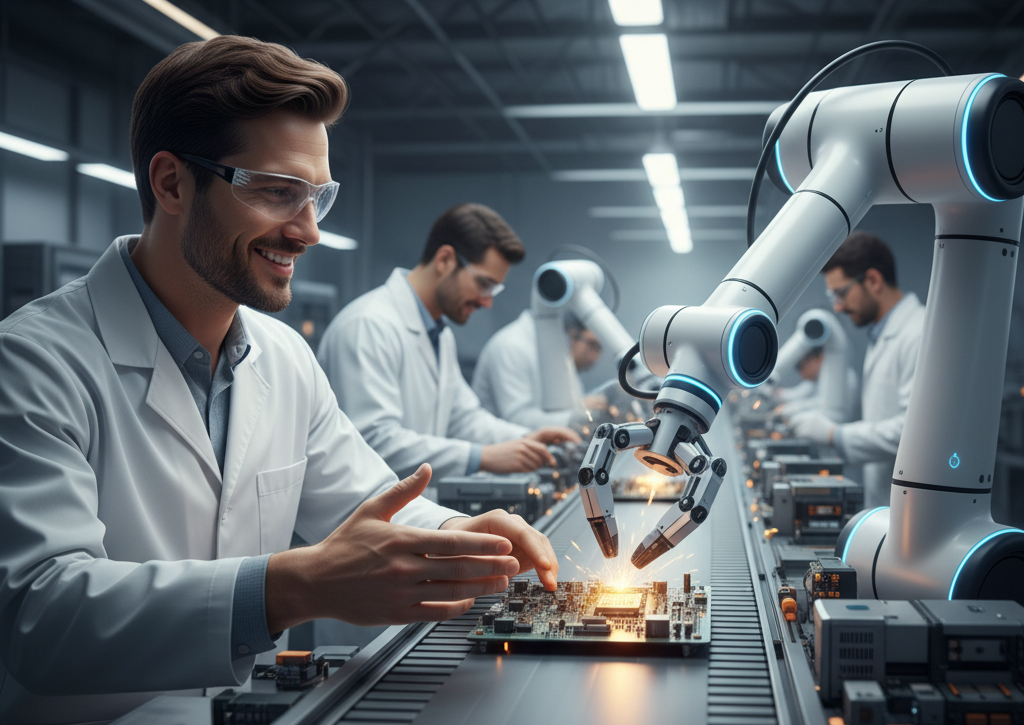
Case studies of cobot integration in production lines
Collaborative robots—better known as cobots—are redefining the relationship between humans and machines across modern production environments. Unlike traditional industrial robots that operate in fenced-off, isolated zones, cobots are engineered to work safely beside human workers, sharing tasks, workspaces, and even decision-making responsibilities. As industries face labor shortages, rising production complexity, and the push toward Industry 4.0, cobots have emerged as one of the most accessible and transformative automation technologies available.
In today’s manufacturing landscape, “collaboration” is no longer just a buzzword—it’s the core mechanism that enables efficiency, quality, and resilience. Cobots represent a shift away from the idea of automation as a replacement for labor, and toward automation as an augmentation of human skills. This article explores how cobots are deployed in real production lines across automotive, electronics, food processing, and small manufacturing operations—and why they are reshaping the future of human–machine partnerships.
What Makes a Cobot Different?

Cobots are built from the ground up to operate safely around human workers without the need for cages or extensive safety barriers. They incorporate a suite of advanced technologies to make this possible:
- Force and torque sensing: Allows the robot to detect unexpected contact and stop immediately.
- Vision systems: Cameras and 3D sensors enable part recognition, object tracking, and adaptive motion.
- Lightweight, ergonomic design: Cobots typically weigh less and are easier to relocate than industrial robots.
- Intuitive programming interfaces: Many can be programmed by physically guiding the arm through the desired motion.
- AI-driven motion and path planning: Allows cobots to adjust their behavior based on the task or environment.
Unlike traditional industrial robots—designed for high-speed, repeatable tasks—cobots excel in variable, small-batch, and human-centric workflows. They thrive in environments where products change frequently, precision is critical, or space is limited.
Why Cobot Adoption is Accelerating

Global trends like aging workforces, tighter production tolerances, and volatile market demand are pushing companies to adopt more flexible automation. Cobots offer several clear advantages:
- Lower upfront investment than conventional robots.
- Rapid integration—deployment times can be days or weeks, not months.
- Higher ROI due to minimal infrastructure modification.
- Scalability for SMEs, enabling automation in sectors previously priced out.
- Ability to balance human adaptability with robotic consistency.
These factors have dramatically expanded cobot use cases beyond traditional heavy manufacturing into electronics, food processing, logistics, pharmaceuticals, and small-scale factories.
Below are four case studies showing cobots in action.
Case Study #1: Automotive Assembly Lines
Manufacturers like BMW, Toyota, and Ford have been pioneers in cobot integration. In automotive assembly—where precision and repeatability directly affect safety—cobots now assist human workers in tasks such as:
- Fastening screws and bolts
- Installing interior components
- Handling heavy parts
- Applying adhesives
- Performing vision-based inspection
Example: BMW’s Cobot-Enabled Assembly Cells
BMW uses cobots to assist technicians in installing sound insulation panels and doors. Workers guide the robot during the first few cycles, after which the cobot repeats the process with millimeter accuracy.
Outcomes:
- Reduced worker fatigue in physically demanding tasks
- 12–15% cycle-time improvements in some processes
- Fewer ergonomic injuries
- Higher consistency in adhesive and fastening operations
These hybrid workstations demonstrate why cobots are favored in environments that still depend heavily on human craftsmanship.
Case Study #2: Electronics and Precision Manufacturing
Electronics assembly—where components are small, delicate, and sensitive—requires accuracy beyond human capability. This has made cobots ideal for:
- Micro-assembly
- High-precision soldering
- Vision-based quality inspection
- PCB handling and testing
Example: Omron and Panasonic’s High-Precision Cobot Cells
Factories in Japan and Southeast Asia deploy cobots equipped with advanced vision systems to detect imperfections invisible to the human eye.
Results include:
- Defect rates reduced by up to 30%
- Continuous quality control without worker fatigue
- Safe handling of delicate components
- Streamlined workflows for mixed-model production
Cobots’ precision and repeatability make them indispensable in industries where error margins are measured in microns.
Case Study #3: Food, Packaging, and Consumer Goods
Cobots are now increasingly deployed in hygienic environments where strict regulatory standards must be maintained. Companies like Nestlé, Unilever, and Kraft Heinz use cobots for:
- Packaging and labeling
- End-of-line palletizing
- Sorting and inspection
- Lightweight pick-and-place
Example: UR Cobots in Food Packaging Lines
Universal Robots (UR) cobots are used in small packaging plants where product variability is high. Operators can retrain cobots in minutes to accommodate new SKUs, seasonal packaging, or limited-time promotional items.
Benefits:
- Quick changeover time
- Reduced contamination risk (minimal human touch)
- Higher throughput with lower labor strain
- Cost-effective compliance with safety standards
This flexibility is why food and beverage processing is one of the fastest-growing sectors for cobot deployment.
Case Study #4: SMEs and the Rise of “Automation for All”
Historically, automation was a luxury available only to large manufacturers with deep budgets. Cobots have changed that landscape. Small and medium enterprises—across metal fabrication, injection molding, woodworking, and craft manufacturing—now use cobots to:
- Tend CNC machines
- Handle repetitive manual tasks.
- Pack and palletize orders.
- Assist with welding, polishing, and deburring.
Example: Metal Fabrication SME + Cobot Welder
A mid-sized metal shop in Europe integrated a cobot-based welding system that operators can program using a simple touchscreen interface.
Impact:
- 40% increase in welding throughput
- Reduced scrap rates
- Better utilization of skilled welders, who now focus on complex tasks
- ROI achieved in less than 12 months
Cobots empower SMEs to maintain competitiveness without hiring large numbers of specialized workers.
Challenges and Limitations of Cobot Integration

While cobots are powerful tools, they are not without constraints:
- Payload limitations
Most cobots handle 3–20 kg, far less than traditional robots. - Slower movement speeds
To remain safe near humans, cobots operate at reduced speeds, limiting throughput in high-volume lines. - Safety concerns in hybrid environments
Even with sensors, fast-moving equipment and cobots must be carefully orchestrated. - Workforce adaptation
Employees may initially resist automation or lack training in basic robot programming. - Cybersecurity risks
Networked robotics systems must be protected from unauthorized access.
These challenges highlight the importance of proper deployment planning, training, and risk assessment.
The Future of Human-Robot Partnership

The next decade will see cobots evolve from assistive tools to intelligent collaborators. Key advancements include:
- AI-driven autonomous task adaptation
- Enhanced tactile sensing for finer manipulation
- Smart grippers that approximate human dexterity
- Mobile cobots (AMR + Cobot hybrids)
- Digital twin simulations for faster programming and changeover
Cobots will also become major enablers of hyper-flexible production—allowing factories to shift from mass production to mass personalization without sacrificing efficiency.
Continue reading: Can Robot Companions Conquer Loneliness?
Cobots as a Catalyst for a Human-Centric Industry 4.0
Cobots are transforming the fundamental nature of industrial work. Across automotive, electronics, food processing, and small-scale manufacturing, cobots enhance quality, improve ergonomics, and boost productivity—while keeping humans firmly at the center of innovation. The evidence from global case studies is clear: cobots don’t replace people; they empower them.
As Industry 4.0 continues to evolve, the factories that thrive will be those that leverage the strengths of both humans and robots. In this new era of human–machine partnership, cobots represent not just a tool but a philosophy—one where collaboration drives progress, flexibility fuels competitiveness, and innovation is shared between humans and intelligent machines.
Continue reading: Vision Systems in Robotics: Seeing is Believing


