


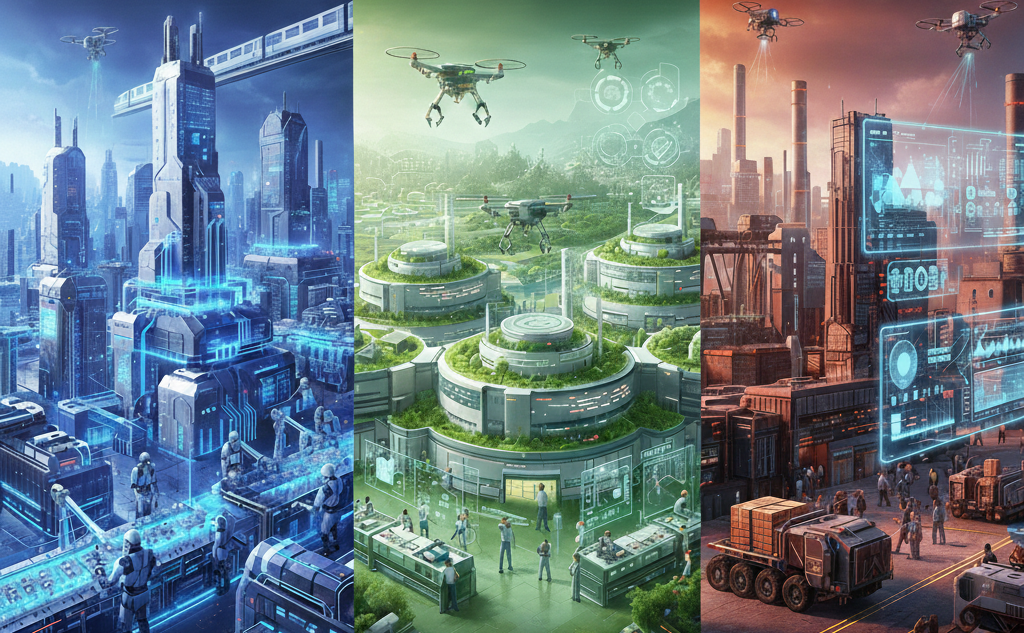
For decades, global manufacturing leadership was defined by labor cost, proximity to raw materials, and export capacity. That equation is rapidly changing. Today, the most competitive manufacturing hubs are distinguished not by scale alone, but by how effectively they adopt advanced technologies—AI, industrial IoT, robotics, digital twins, and data-driven automation.
As manufacturers rethink supply chains, resilience, and productivity, three regions dominate the conversation: Asia, Europe, and the United States. Each is investing heavily in smart manufacturing, but their approaches, strengths, and trajectories differ in meaningful ways. Understanding those differences is critical for manufacturers, investors, and policymakers planning for the next decade of industrial growth.
Further reading: Smart Factories 4.0: How AI and IoT Are Rewiring Global Manufacturing
The Global Shift Toward Smart Manufacturing
Smart manufacturing—often grouped under the banner of Industry 4.0—refers to the integration of digital technologies across the production lifecycle. Connected machines, real-time analytics, automation, and AI are enabling factories to operate with greater efficiency, flexibility, and visibility than ever before.
Globally, manufacturers are pursuing these technologies to solve common challenges: labor shortages, rising energy costs, supply chain volatility, and pressure to reduce emissions. While adoption is accelerating worldwide, regional priorities and execution models vary widely.
Asia: Scale, Speed, and State-Backed Transformation

Asia has emerged as the world’s most dynamic smart manufacturing region, combining unmatched production scale with aggressive technology deployment.
China remains the dominant force, investing heavily in factory automation, industrial robotics, and digital infrastructure. National initiatives aimed at upgrading manufacturing capabilities have accelerated the rollout of smart factories, particularly in automotive, electronics, and heavy industry. The defining characteristic of China’s approach is scale—new technologies are deployed across vast production networks at speed.
Japan and South Korea bring a different strength to the region: precision. Both countries lead globally in robotics density and advanced manufacturing processes. Their factories emphasize reliability, quality control, and deep integration between hardware and software—traits that make them global benchmarks for industrial excellence.
India represents a different, but increasingly important, dimension. While still earlier in large-scale smart factory adoption, India is investing heavily in digital manufacturing infrastructure, positioning itself as a future growth hub as labor markets and supply chains continue to shift.
Asia’s advantage lies in its ability to combine government support, manufacturing scale, and rapid execution. Its primary challenge is uneven adoption—advanced smart factories coexist with legacy operations, particularly among smaller suppliers.
United States: Innovation, Software, and Advanced Use Cases

The United States approaches smart manufacturing from a fundamentally different angle. Rather than focusing on scale, U.S. leadership is driven by innovation ecosystems—a combination of advanced software, AI research, and strong collaboration between industry, startups, and academia.
American manufacturers lead in areas such as predictive maintenance, AI-driven quality control, and real-time production analytics. These technologies are often layered onto existing facilities, modernizing legacy plants rather than replacing them outright. The result is a highly advanced, data-centric manufacturing environment, particularly in sectors like aerospace, automotive, healthcare equipment, and semiconductors.
Another defining feature of U.S. manufacturing hubs is their role as testing grounds. New automation systems, industrial AI platforms, and digital twin technologies are frequently piloted and refined in the U.S. before being scaled globally.
However, the U.S. also faces structural challenges. Retrofitting older facilities can be costly, and high labor and energy costs place pressure on margins. As a result, adoption tends to be deep but uneven, concentrated among larger manufacturers and advanced industries.
Europe: Precision Engineering and Sustainability Leadership

Europe occupies a distinct position in the global manufacturing landscape, balancing technological sophistication with regulatory and sustainability priorities.
Germany remains the anchor of Europe’s smart manufacturing ecosystem, with strong adoption of digital twins, advanced robotics, and factory automation—particularly in automotive and industrial machinery. Across the continent, manufacturers emphasize interoperability, standards, and long-term system reliability.
What truly differentiates Europe is its alignment between smart manufacturing and sustainability. European factories are increasingly designed to optimize energy usage, reduce emissions, and support circular manufacturing models. Digital technologies are used not only to improve productivity, but also to meet stringent environmental and regulatory requirements.
The challenge for Europe lies in fragmentation. Unlike the U.S. or China, manufacturing investment and policy are distributed across many national markets, each with its own priorities. This can slow continent-wide scaling, even as individual countries achieve high levels of sophistication.
Comparing the Leading Manufacturing Regions
While all three regions are advancing rapidly, their leadership takes different forms.
Asia leads in deployment speed and scale, making it the world’s largest and fastest-growing smart manufacturing region. The United States leads in innovation and advanced use cases, particularly where AI and software redefine how factories operate. Europe leads in precision, standards, and sustainable industrial design, setting benchmarks for responsible manufacturing.
Rather than competing directly, these regions increasingly complement one another within global value chains—innovation originating in one region, scaled in another, and refined through regulatory and sustainability frameworks elsewhere.
| Region | Market Share/Growth | Key Strengths | Primary Challenges |
| Asia | Largest & fastest growth | Scale, govt initiatives | Skill gaps, capital for SMEs |
| U.S./North America | Tech leadership, high R&D | Innovation ecosystem | High costs, legacy systems |
| Europe | Strong adoption + sustainability | Compliance, precision industries | Fragmented national markets |
The Future of Global Manufacturing Hubs

Looking ahead, the definition of a manufacturing hub will continue to evolve. Leadership will depend less on geography alone and more on the ability to integrate technology, talent, and resilience into production systems.
Emerging hubs in Southeast Asia, Eastern Europe, and parts of the Middle East are already leveraging lessons from established leaders, adopting smart manufacturing technologies earlier in their industrial development cycles. At the same time, geopolitical shifts and supply chain re-localization are pushing established regions to invest even more aggressively in automation and digitalization.
By 2030, the most successful manufacturing hubs will not be those that simply produce the most—but those that produce intelligently, adapt quickly, and operate sustainably.
Frequently Asked Questions
What is a smart manufacturing hub?
A smart manufacturing hub is a region where advanced production technologies—such as industrial IoT, automation, AI, robotics, and data analytics—are widely adopted across factories and supply chains. These hubs typically combine strong infrastructure, skilled labor, digital connectivity, and supportive industrial policy to enable efficient, flexible, and resilient manufacturing.
Which region leads the world in smart manufacturing adoption?
Asia currently leads in overall smart manufacturing adoption, driven by large-scale investments and rapid deployment across China, Japan, and South Korea. The United States leads in advanced applications and industrial AI innovation, while Europe is recognized for precision engineering, interoperability standards, and sustainability-driven manufacturing.
Why is Asia considered the fastest-growing manufacturing region?
Asia’s growth is fueled by a combination of government-backed industrial policies, expanding domestic markets, and aggressive investment in automation and robotics. Many Asian manufacturers are building smart factories from the ground up, allowing them to adopt modern technologies faster than regions constrained by legacy infrastructure.
How does the U.S. approach smart manufacturing differently?
The U.S. focuses heavily on software, AI, and data-driven manufacturing. Rather than replacing entire factories, many U.S. manufacturers modernize existing facilities with predictive maintenance, real-time analytics, and digital twins. This approach prioritizes innovation and flexibility over large-scale greenfield expansion.
What makes Europe a leader in sustainable manufacturing?
European manufacturing integrates smart technologies with strict environmental and regulatory standards. Digital systems are often deployed to optimize energy use, reduce emissions, and support circular manufacturing models, making sustainability a core driver of technological adoption rather than a secondary benefit.
Conclusion
Asia, Europe, and the United States are all shaping the future of manufacturing—but in distinct ways. Asia brings unmatched scale and momentum, the U.S. delivers cutting-edge innovation, and Europe provides a model for precision and sustainable industrial growth.
For manufacturers and investors, understanding these regional strengths is no longer optional. As smart manufacturing becomes the global standard, strategic decisions about where—and how—to build will define competitiveness for decades to come.
Further reading: Society 5.0 in Practice: What Japanese Manufacturers Are Doing


