


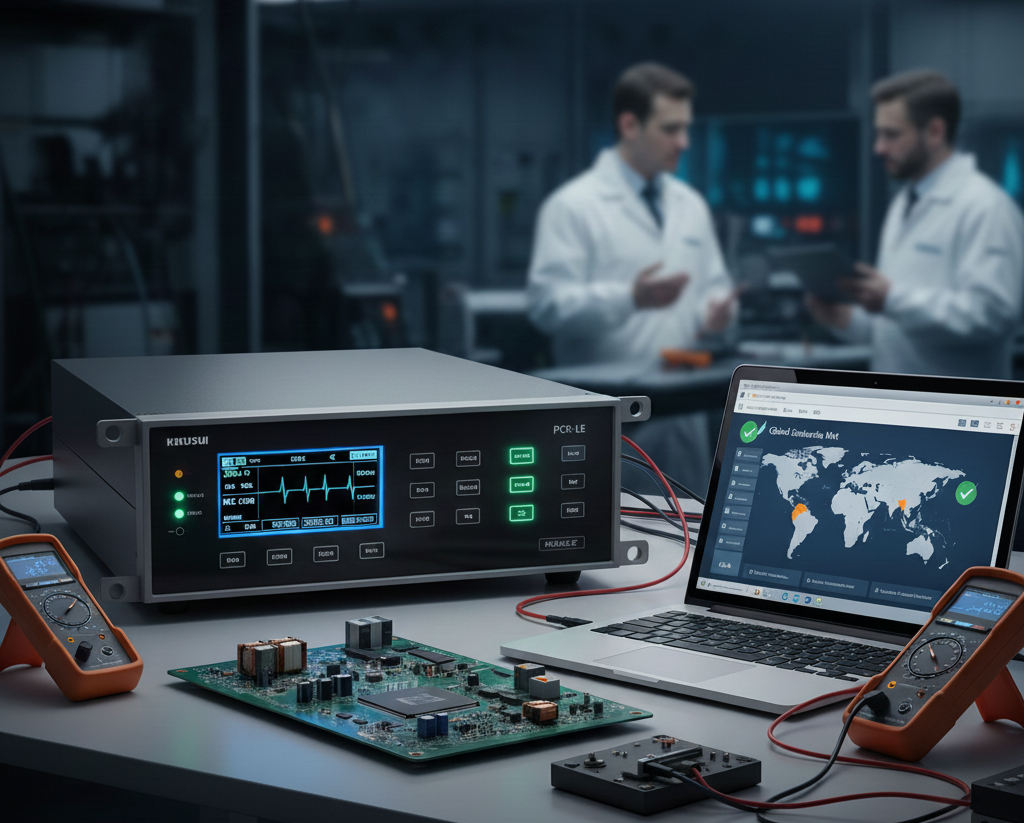
Meeting global electrical compliance requirements is one of the biggest challenges in manufacturing electronics and power systems today. A product destined for the U.S., Europe, China, and Japan must operate safely under different national grid standards, voltage characteristics, and failure conditions.
This is why R&D and production teams increasingly rely on programmable AC power supplies to accelerate certification and validation.
The Global Compliance Challenge

Bringing an electronic or power-dependent product to global markets is no longer just about meeting a single standard—it’s about navigating a complex web of regional electrical requirements, safety regulations, and real-world grid conditions. A device that performs flawlessly in one country might fail certification in another due to differences in voltage stability, frequency, harmonics, or power quality.
For engineering teams, this creates a significant challenge: how to validate a product against all these conditions without slowing development or relying on inconsistent manual testing. As regulatory bodies tighten requirements and products become more software-defined, the ability to accurately simulate global electrical environments has become essential for achieving compliance and avoiding expensive redesign cycles.
Engineers are expected to account for:
- 100–240 V operating differences
- 50/60 Hz grid frequency
- Grid irregularities and flicker
- Sudden voltage dips
- Inrush loads
- Firmware-controlled startup behavior
- Harmonic distortion impact
Testing these conditions manually is time-consuming and hard to replicate. Programmable AC sources solve this by letting engineers automate realistic electrical scenarios and store them for repeated use.
What Today’s Validation Labs Need
As products become more interconnected and power-dense, validation labs are expected to simulate real-world electrical conditions with absolute consistency and repeatability. It’s no longer enough to just “apply power and observe”—engineers need controlled, programmable environments where every voltage dip, surge, harmonic, and transient can be reproduced down to the millisecond.
Modern validation labs, therefore, require AC sources that support automation, precision, and seamless integration with test benches, data acquisition systems, and software environments. The goal is to eliminate manual variability, accelerate compliance workflows, and ensure every test run produces reliable, traceable results.
Automation
Execute full sequences without operator intervention:
- Line dip at 30%
- Frequency switch
- Rapid recovery
- Result logging
Accuracy
Compliance is binary—pass or fail—and power supplies must offer:
- Tight voltage regulation
- Clean sine wave output
- Fast dynamic response
Integration with Lab Systems
SCPI control, LAN/USB interfaces, LabVIEW/Python support, and machine log output are now essential for continuous improvement and full traceability.
Example: Purpose-Built Solutions for Industry

Not all AC power supplies are created equal—especially when it comes to high-stakes validation environments. While generic lab equipment may handle basic tasks, industries such as automotive, aerospace, industrial automation, and consumer electronics require specialized AC sources engineered for continuous operation, precise waveform control, and strict compliance workflows. These sectors depend on equipment that can reliably reproduce global grid conditions, execute automated test sequences, and integrate seamlessly with modern R&D and production systems.
This is where purpose-built, industrial-grade solutions stand out. Manufacturers increasingly turn to vendors that design AC power supplies specifically for rigorous engineering demands—not just general-purpose lab use. Kikusui America’s AC power supply lineup addresses the core performance, safety, and automation requirements common in advanced electronics testing and certification.
Their AC line includes solutions for:
- IEC/UL product safety testing
- EV onboard charger validation
- PSU and inverter evaluation
- Motor and control electronics development
- Automated production pass/fail inspection
ROI for Manufacturer
In an era where product cycles are shrinking and compliance demands continue to rise, the return on investment for high-quality AC power supplies goes far beyond accurate voltage output. For manufacturers, the real value comes from operational efficiency, faster market entry, and reduced risk.
By automating complex electrical tests, minimizing human error, and enabling precise repeatability, modern AC sources help companies avoid costly redesigns, accelerate certification timelines, and maintain consistent production quality. The result is a measurable impact on both engineering productivity and overall business performance.
A properly engineered AC source provides:
| Benefit | Impact |
| Automated, consistent testing | Eliminates operator variability |
| Faster certification cycles | Shortens time-to-market |
| Fewer late-stage failures | Lowers rework and redesign costs |
| Better engineering visibility | Data + logging supports continuous improvement |
As products become more software-defined and the electrical world becomes more complex, programmable AC power supplies are evolving from lab tools into mission-critical infrastructure. For manufacturers competing in high-performance and highly-regulated industries, the right AC system is not just about meeting standards—it’s about building better products, faster.


