


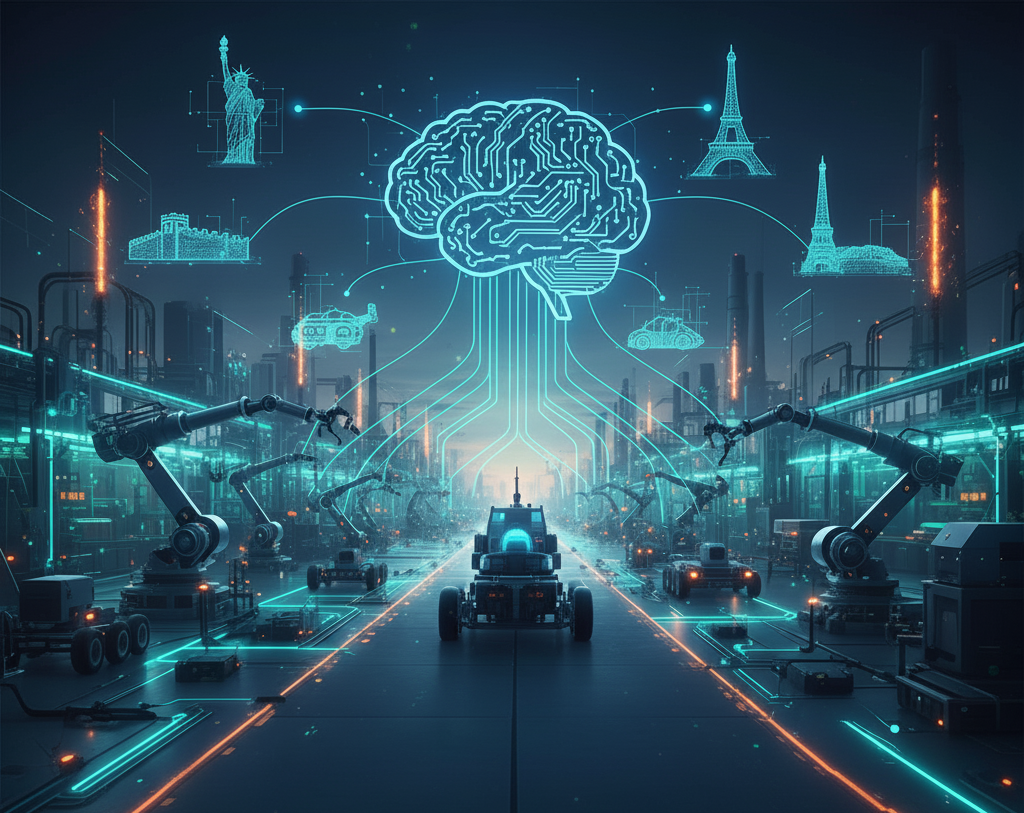
A New Phase of Industrial Evolution
Manufacturing is undergoing the most significant transformation since the introduction of mass production. Powered by artificial intelligence (AI), the Industrial Internet of Things (IIoT), and automation, smart factories are fundamentally changing how products are made, how data is used, and how decisions are made on the factory floor. Once slow-moving and capital-intensive, the industry is now evolving toward systems that are connected, intelligent, and increasingly autonomous.
This shift is not optional. Manufacturers now face rising labor shortages, demand for customization, global competitive pressures, sustainability mandates, and shorter time-to-market expectations. Smart factories—fully integrated environments where machines talk to each other, data flows continuously, and decisions are enhanced or executed by AI—are emerging as the solution. Industry 4.0 represents not just new technology, but a new operating model for global manufacturing.
Further reading: Why Japan’s Manufacturing DNA Matters in the Global Industry 4.0 Race
What Defines a Smart Factory?

A smart factory is not defined by any single technology, but rather the convergence of several:
- Connected machines and sensors feeding real-time data
- AI models interpreting data and making recommendations—or taking action
- Operators, equipment, and software systems are integrated into one digital ecosystem
- Continuous learning and optimization over time
In traditional plants, data is scattered, manually captured, or siloed across aging systems. In a smart factory, data becomes a strategic asset—captured automatically, analyzed continuously, and used to improve production hour by hour.
How IoT Is Transforming the Factory Floor

The Industrial Internet of Things (IIoT) is the digital backbone of modern manufacturing. By equipping machines with sensors that continuously stream data into cloud or local analytics platforms, factories gain unprecedented transparency and control over their operations.
Real-Time Machine Monitoring
Real-time monitoring allows operators to instantly view equipment status, utilization rates, error conditions, and environmental variables such as temperature, vibration, and pressure. Small anomalies can be detected and addressed before they escalate into major failures, giving decision-makers actionable insights in minutes rather than hours or days.
Full-Process Traceability
Beyond monitoring, IoT provides full traceability across the production lifecycle—from inbound components to finished goods. This simplifies audits, improves regulatory alignment, strengthens supplier verification, and makes it easier to identify precisely which machines, shifts, or batches contributed to a quality issue.
Data-Driven Continuous Improvement
Historical production data also becomes a powerful engine for continuous improvement. Rather than relying on intuition or tribal knowledge, manufacturers can detect bottlenecks, optimize cycle times, improve equipment configuration, and increase yield using empirical performance trends. In short, IoT turns the entire factory floor into a measurable, traceable, and continuously improving system.
Artificial Intelligence: The Brain of the Smart Factory

If IoT is responsible for capturing data, artificial intelligence is responsible for transforming it into value. Advanced machine-learning models now replicate and often surpass the intuition of seasoned engineers by analyzing operational patterns at scale.
Predictive Maintenance
Predictive maintenance is one of the most impactful applications. Instead of waiting for breakdowns or relying on fixed-interval servicing. AI models forecast failures before they occur, allowing maintenance activities to be performed precisely when needed. This results in higher uptime, lower service costs, and longer equipment life.
Automated Quality Inspection
AI is also reshaping production quality. Computer vision systems can identify defects such as surface inconsistencies, micro-cracks, alignment issues, and misplaced components with greater accuracy than the human eye. This leads to better consistency, fewer customer returns, and faster feedback loops to upstream processes.
Intelligent Scheduling
AI-powered scheduling further enhances production efficiency by analyzing machine availability, labor capacity, inventory levels, and historical performance to automatically generate optimized production plans—particularly valuable in fast-moving sectors like consumer electronics.
Even complex process changes can be simulated before real-world deployment thanks to digital twins, virtual replicas of lines or entire plants that reduce engineering risk and accelerate new product introduction.
Automation and Robotics in the Smart Factory

Autonomous Mobile Robots
Hardware innovation remains a key pillar of digital transformation. Collaborative robots (cobots) are especially transformative because they can operate safely alongside humans without full protective enclosures. Their ease of deployment, compact footprint, and flexibility make them ideal for smaller and mid-sized facilities.
Cobots excel at repetitive, labor-intensive functions such as loading CNC machines, performing pick-and-place tasks, conducting assembly inspections, or handling small materials, freeing skilled workers to focus on higher-value activities.
Adaptive, Learning Automation
Automation is also moving beyond human-robot interaction into internal material logistics. Autonomous mobile robots (AMRs) and automated guided vehicles (AGVs) transport components and tools between workstations, support just-in-time manufacturing, and reduce unproductive manual movement.
Even more important, the newest generation of robotic systems learns and adapts. Instead of relying exclusively on fixed programming, machines can refine motion paths, improve positioning accuracy, react to changing conditions, and supports frequent product variations with minimal reprogramming. This adaptive automation enables plants to stay agile in markets where product cycles continue to shrink.
Smart Factory Transformation in Action: Case Examples
Many industries are already seeing measurable returns from smart factory investment.
Automotive Manufacturing
A major automotive plant integrated AI-driven predictive maintenance and saw:
- Downtime reduced by double-digit percentages
- Millions in cost avoidance
- Higher throughput with no additional hardware
Predictive analytics fundamentally changed how the maintenance organization operated.
Electronics Assembly
A circuit board manufacturer deployed computer vision inspection systems and achieved:
- Higher defect detection rates
- Faster feedback loops
- Reduced rework
Yield improved without redesigning equipment or workflows.
Food and Beverage Production
IoT-powered monitoring allowed a beverage facility to track:
- Temperature
- Microbial risks
- Cleaning compliance
- Packaging integrity
The result was reduced waste, better product consistency, and a simplified audit process.
Further reading: Predictive Maintenance: The Data-Driven Solution to Industrial Downtime
Business Benefits of Smart Factories

When fully implemented, smart factories provide measurable strategic and operational advantages, uptime improves as machines self-monitor, maintenance becomes predictive, and scheduling dynamically adjusts to real-time conditions.
Quality increases through automated inspection and rapid feedback, while reduced scrap and fewer returns protect margins and strengthen brand perception. Operating costs decline as energy use, maintenance activities, and defect rates drop, and production flexibility rises through rapid reconfiguration, faster introduction of new SKUs, and ability to increase capacity digitally rather than solely through capital expansion.
Ultimately, data becomes a competitive asset, shifting decision-making from experience-based judgment to model-driven performance control.
Challenges Slowing Full Adoption
Despite the compelling advantages, widespread smart factory adoption is not without obstacles.
Legacy Equipment Integration
Many plants still rely on legacy equipment that requires sensor retrofits, gateway devices, or software upgrades before data can be captured and digitized—a task that can be complex in environments with decades-old machinery and proprietary control systems.
Cybersecurity Exposure
Increased connectivity also creates cybersecurity concerns, pushing manufacturers toward stronger authentication, continuous monitoring, network segmentation, and zero-trust frameworks to protect operational infrastructure.
Skills Gap
Workforce capability represents another challenge. Operators, technicians, and maintenance professionals increasingly need data literacy, familiarity with automation programming, and comfort using AI-driven tools. For many companies, workforce development is becoming a strategic priority rather than a support function.
Upfront Investment
Finally, the financial investment required for hardware, software, system integration, and training can be substantial. In industries with long procurement cycles and conservative approval processes, demonstrating ROI early is essential to securing executive support.
The Future of Smart Manufacturing

The next phase of Industry 4.0 will be defined by:
Autonomous Production
AI will move from supporting operations to managing them end-to-end. Production scheduling, workflow adjustments, maintenance prioritization, and even quality decisions will increasingly be handled automatically. Instead of reacting to disruptions, factories will anticipate and correct them in real time, resulting in higher utilization and smoother throughput with less human intervention.
Fully Connected Supply Chains
Smart manufacturing will not stop at the factory walls. Every stage—from raw material sourcing to delivery and customer feedback—will become part of a continuous digital thread. With supply, production, logistics, and demand data fully synchronized, manufacturers will gain unprecedented visibility into constraints, risks, and cost opportunities. This enables faster decision-making, improved resiliency, and tighter alignment between market needs and factory output.
Continuous Machine Learning Improvement
Machine-learning models will refine themselves as they ingest more production data, learning from patterns that humans may never detect. Rather than requiring manual reprogramming, systems will evolve organically, improving accuracy, predicting failures earlier, and adapting to new product variations or process conditions. Factories will effectively become living systems that get smarter over time.
Manufacturing-as-a-Service
A growing shift toward subscription-based industrial solutions will reduce the barriers that have historically slowed digital adoption. Instead of large upfront CAPEX equipment, monitoring systems, AI tools, or analytics platforms, manufacturers can increasingly access scalable services on an OPEX model. This democratizes advanced manufacturing technologies, enabling small and mid-sized factories to compete with enterprise-level operations—accelerating modernization across entire sectors.
Further reading: Consumer Robotics: Solutions You Can Use Today
A Permanent Shift in Industrial Strategy
Smart factories represent a structural change in how global manufacturing operates. AI, automation, IoT, and digital intelligence are transforming production from reactive and manual to predictive, interconnected, and data-driven. While challenges remain, early adopters are already experiencing higher efficiency, stronger competitiveness, and greater adaptability in volatile global markets. The factories that embrace their capabilities today will set the performance benchmark for the next decade of industrial innovation.
Further reading: The Global Shift Toward Smart Manufacturing: Market Outlook 2026


