


Energy & Green Manufacturing
Sustainability has entered a new era in manufacturing—one driven less by corporate slogans and more by engineering realities. Rising energy prices, tightening regulations, and increasingly electrified production systems have forced manufacturers to treat sustainability not as a reporting exercise, but as an operational discipline. The focus has shifted from broad pronouncements about “going green” to the concrete work of reducing emissions, optimizing energy use, and designing products and facilities that use materials more intelligently and more efficiently.
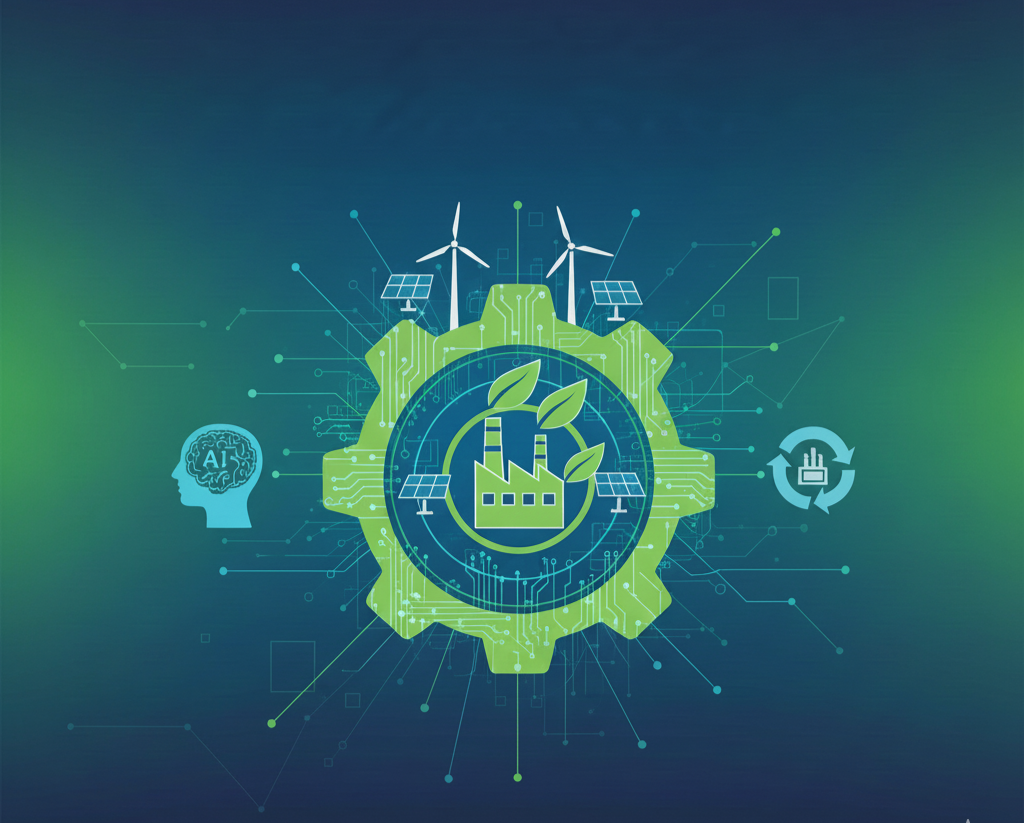
This article discusses the three areas that are reshaping how factories operate: the decarbonization of the factory floor, the application of AI for energy optimization, and the emergence of circular manufacturing business models. Together, these represent the most technically meaningful levers for sustainable production in the decade ahead.
Further reading: Smart Factories 4.0: How AI and IoT Are Rewiring Global Manufacturing
Decarbonizing the Factory Floor: Where Emissions Really Come From

Most conversations about industrial sustainability start and end with high-level carbon reporting. But to actually decarbonize manufacturing, engineers first need a clear picture of what truly drives emissions within the four walls of a factory and across its immediate supply chain.
Understanding the True Industrial Carbon Footprint
A typical factory’s carbon footprint is dominated by energy consumption—particularly electricity, process heat, and any fossil-fuel-based thermal systems. Compressed air systems, HVAC, and environmental controls also consume significant energy, often more than operators expect. Equipment inefficiencies compound the problem: legacy motors, poorly tuned drives, and machines left idling for long periods can quietly burn through enormous amounts of electricity. Add in scrap rates, inefficient material handling systems, or upstream emissions tied to material production, and the real carbon story becomes far more complex than standard reporting categories suggest.
High-Impact Areas Often Overlooked
Decarbonization efforts with the highest impact usually begin with a detailed energy study. Engineers map out exactly which machines consume the most power and under what conditions. This often reveals surprising patterns—lines where machines run at full power during idle segments, thermal processes that lack proper insulation, or conveyors that operate continuously regardless of upstream or downstream flow. From there, targeted engineering interventions become possible. High-efficiency motor upgrades, intelligent drive tuning, heat recovery systems, and real-time monitoring via IIoT sensors all contribute to meaningful CO₂ reductions. Even modest improvements in cycle time optimization or idle reduction can deliver outsized benefits.
Technical Strategies for Reduction
A growing number of manufacturers are rediscovering the value of process-level redesign. Electrifying thermal processes where possible, consolidating machine tasks to reduce idle power, and introducing smart controls that adjust in real time based on load conditions all add up. One automotive supplier, for example, cut emissions by double digits simply by integrating energy metering into its MES system and adjusting production scheduling to avoid peak electricity periods. Decarbonization, in other words, starts with understanding the technical realities of the factory floor—not with marketing narratives.
Further reading: How Startups Are Driving Innovation in Industrial Tech
AI for Energy Optimization: Cutting Electricity Use Without Slowing Production

The Problem: Factories Waste Energy in Invisible Ways
Even highly optimized facilities waste energy in invisible ways. Machines often draw substantial power even when not actively producing. HVAC systems overcompensate for small temperature fluctuations. AGVs and mobile robots charge on inefficient schedules. Production cells may ramp up or cool down at times that do not align with real demand. These inefficiencies accumulate, making energy optimization one of the highest-ROI opportunities in modern manufacturing.
How AI Actually Saves Energy
This is where AI has become a transformative tool. Machine learning models can forecast power loads with remarkable accuracy, allowing factories to anticipate peaks and shift noncritical operations to off-peak times. AI-driven scheduling engines can sequence production tasks in ways that reduce overall load, prevent unnecessary machine warm-up cycles, and coordinate energy-intensive operations so they do not overlap. In robotics, motion optimization algorithms can reduce torque demand, heat generation, and therefore energy usage, without slowing cycle times.
Integration With Factory Systems
Integrating these capabilities into factory systems requires a thoughtful approach. Energy data must be collected at the machine, line, and facility levels, normalized, and fed into analytics platforms capable of generating real-time insights. AI deployed at the edge (near machines) handles fast-response scenarios such as dynamic motor control, while more computationally intensive forecasting or optimization can run in the cloud. When implemented correctly, these solutions allow manufacturers to cut energy consumption significantly without sacrificing throughput.
Further reading: Predictive Maintenance: The Data-Driven Solution to Industrial Downtime
Materials Circularity in Manufacturing: New Business Models Emerging

Why Circularity Is Becoming a Business Imperative
Sustainability does not end with energy. Raw materials, product life cycles, and end-of-life strategies play an equally important role—and increasingly shape business competitiveness. Circularity in manufacturing has moved far beyond recycling bins or waste reduction initiatives; it is becoming a core design and operational principle.
Core Pillars of Materials Circularity
Circular manufacturing begins with designing products for easier disassembly, modular upgrades, and component reuse. Instead of replacing entire systems, manufacturers refurbish products—extending life cycles and reducing material demand. Remanufacturing restores used products to like-new performance, while component harvesting allows high-value parts to be reused rather than scrapped. Manufacturers are also integrating traceability technologies such as RFID and machine vision to track a component’s lifecycle, making circular strategies not only possible but economically viable.
Technologies Enabling Circular Manufacturing
These technical capabilities are giving rise to entirely new business models. Refurbishment-as-a-Service programs enable companies to offer customers ongoing product renewals instead of one-time purchases. Buy-back and upgrade programs create predictable material return flows. Subscription-based equipment models ensure products are recovered at the end of life and reintegrated into new production cycles. Meanwhile, online marketplaces for reclaimed components are emerging as reliable sources of high-quality materials at lower cost.
Emerging Business Models
One industrial equipment maker, for instance, now recovers and reuses more than 60% of parts from returned units after implementing standardized disassembly processes and automated inspection systems. This not only reduces material dependence but also strengthens resilience against supply chain disruptions—an increasingly important advantage as global markets remain volatile.
Further reading: AC Power Supplies: A Measurement in Advanced Manufacturing
Sustainability as an Engineering Discipline

Across energy, emissions, and materials, one message becomes clear: meaningful sustainability in manufacturing is not about compliance boxes or polished annual reports. It is an engineering discipline. The companies achieving the most measurable progress are those treating sustainability as an operational challenge that demands data, technical skill, smart automation, and thoughtful system design.
The future of sustainable manufacturing will be driven by factories that understand their energy flows, optimize their processes in real time, and build products that fit into circular ecosystems rather than linear waste streams. Achieving this requires the tools of modern industry—IIoT monitoring, AI algorithms, digital twins, and lifecycle-aware design—but it also requires a shift in mindset: sustainability must be approached with the same rigor, precision, and continuous improvement mentality that manufacturers already apply to quality and productivity.
The manufacturers who take this engineering-driven approach will not only reduce their environmental footprint but also become more competitive, more resilient, and more efficient. In an era of rising complexity and rising expectations, that combination may prove to be the strongest advantage of all.
Further reading: Why Japan’s Manufacturing DNA Matters in the Global Industry 4.0 Race


