


In the dynamic world of home technology, a new generation of devices is quietly taking over: robots designed for everyday life.
Whether you’re a B2B professional strategizing the next wave of smart-home solutions or simply a curious robotic enthusiast wondering what “home robotics” actually means, this article is your guide. We will look past the hype to reveal five real-world consumer robotic solutions you can use today and explain how they are engineered to become exponentially smarter in the near future.
Why This Matters Now: A Market in Hyper-Growth
The consumer robotics market (meaning robots built not for factories, but for homes, education, and daily life) is experiencing an explosive growth. This isn’t just a futuristic concept anymore. The numbers speak for themselves!
Current analyses estimate the global consumer robotics market at roughly USD 10.9 billion in 2024, rapidly climbing to approximately USD 13.16 billion in 2025. Experts project a significant Compound Annual Growth Rate (CAGR) of around 25% from 2025 to 2030. (Source: Grand View Research)
What that growth means: This technology is no longer “on the horizon“. It is already landing in real homes. For businesses, this translates into rapidly increasing opportunities for companies that integrate, service, or develop devices for this dynamic market.
For You: Whether you are building smart-home services, exploring household robotics, or just interested in the biggest tech wave since the smartphone, now is the crucial moment to pay attention!
Market Snapshot & The Smart Drivers
While the overall robotics market (spanning industrial, service, and consumer) is massive, the consumer segment is outpacing many others. Why?
The driving force is a powerful combination of maturing technologies:
- Widespread Connectivity: Better smart-home integration (IoT, Wi-Fi/5G, voice assistants).
- Advanced AI: Improved object recognition, predictive learning, and natural voice interaction.
- Affordable Hardware: Cheaper and more powerful sensors and semiconductors.
For both businesses and everyday users, this synergy means that robots are finally moving past being sci-fi curiosities and are transforming into viable, integrated products that genuinely enhance daily life.
So, let’s dive into the five categories of consumer robotics solutions you can use today and how they’re evolving.
1. Cleaning & Maintenance Robots

What They Are Today: The Autonomous Chore Masters
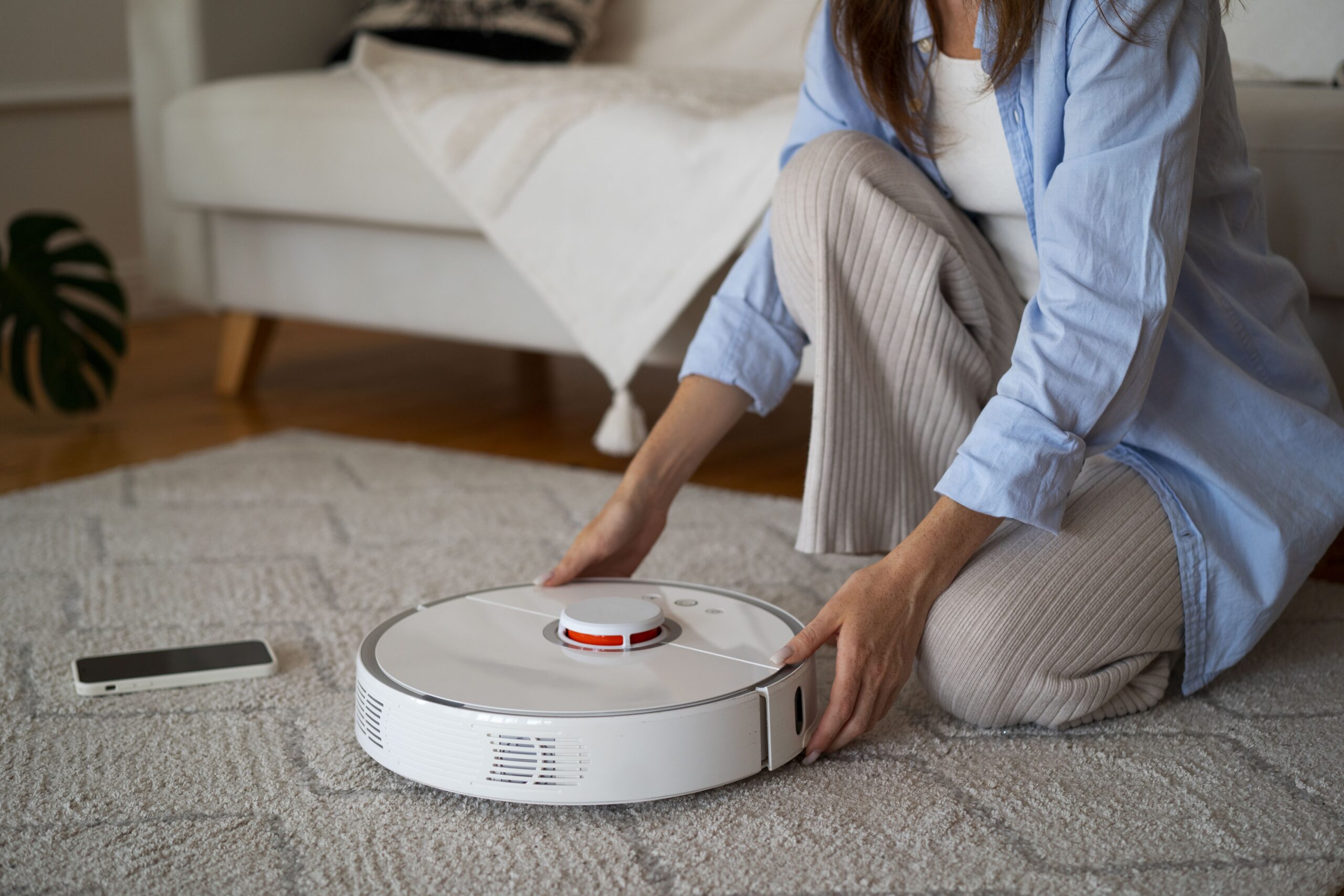
This category includes the most established consumer robot: devices that handle mundane, repetitive chores like vacuuming, mopping, lawn-mowing, and window cleaning. They are the definition of passive convenience.
Market Reality: This isn’t a niche market, it’s a gigantic one! The residential portion of the cleaning robot market was valued at a robust USD 11.8 billion in 2024, with projections showing significant growth toward USD 25.6 billion by 2034. (Source: Global Market Insights Inc.) Floor cleaning and mopping robots currently capture over 65% of the household robotics market, confirming their status as a mainstream appliance.
Present-Day Benefit: For the homeowner, the value proposition is simple: minimal intervention. (Source: Robot Magazine) Imagine walking into a clean home or seeing your garden neatly trimmed without lifting a finger. This saves time and mental energy, making it an indispensable convenience.
How They’re Becoming Smarter: From Route to Routine
The latest revolution in cleaning robotics is driven by AI and advanced sensor fusion (LIDAR, vSLAM). They are moving far beyond simple bump-and-turn navigation:
- Environmental Intelligence: Robots now use full home-mapping to understand the layout, differentiate between carpet and hard floors, and identify high-traffic zones for targeted cleaning.
- Object Recognition: Sophisticated units utilize AI-trained cameras to actively identify and avoid small obstacles like cables, socks, and even pet waste, eliminating the frustrating need to “robot-proof” your home before a cleaning run.
- Ecosystem Integration: Expect deeper integration with smart-home systems. A robot vacuum will know when you leave the house (via smart sensor data), automatically start, and then dock itself. Requiring intervention only when the self-emptying bin is full.
- Predictive Maintenance: Future models will signal when a filter needs replacement or a brush is tangled, transforming the robot from a machine you maintain into an assistant that manages its own upkeep.
(Source: Lefant)
For Businesses: The opportunities here are expanding rapidly, moving beyond sales into servicing, maintenance plans, consumable subscriptions, and providing the software/API layers that seamlessly integrate these highly autonomous devices into existing home automation ecosystems.
2. Personal Assistant & Companion Robots

What They Are Today: The Emerging Social Layer
This category covers robots designed for genuine interaction, companionship, and dynamic assistance, which are tasks beyond simple cleaning. Think reminders, light fetching of items, security monitoring, and, crucially, social engagement, particularly for households with older adults or young children.
Current Reality: While we are still waiting for the fully mobile, humanoid home assistant, the foundations are being laid. Products like Samsung’s Ballie (designed as a smart-home companion that can follow owners and interact with smart devices) and dedicated elder-care robots like ElliQ already illustrate the demand for proactive, personalized assistance. This nascent market is rapidly becoming a significant talking point, especially as demographics shift toward an aging population.
Present-Day Benefits:
- Cognitive Support: Provides proactive reminders for appointments and medication, reducing the cognitive load on busy individuals or caregivers.
- Companionship & Connection: Offers friendly interaction, reducing feelings of isolation, particularly beneficial for older adults or in single-person households.
- Simplified Access: These interfaces are designed to be newcomer-friendly, relying heavily on natural voice and adaptive apps, meaning no robotics engineering degree is required to find value.
How They’re Becoming Smarter: Leveraging LLMs for Empathy
The true evolution of companion robots is centered on AI, shifting their capability from simple programming to genuine, adaptive interaction:
- Conversational Fluency: The integration of Large Language Models (LLMs) is the game-changer here. LLMs enable robots to engage in open-ended, coherent conversations, maintaining context and memory across sessions. This moves the interaction from command-and-response to fluid dialogues.
- Emotional Intelligence: Future robots will use sophisticated AI to recognize human moods, intonation, and emotional cues. They won’t just respond to a command, they’ll respond empathetically to the user’s emotional state.
- Autonomous Task Anticipation: Utilizing sensor data and learned routine, these robots will achieve greater autonomy, anticipating household needs (e.g., offering to call a family member at a scheduled time or fetching a common item).
For Business Professionals (The RaaS Model): The emerging model here is “Robotics-as-a-Service” (RaaS), especially in specialized sectors like elder-care and hospitality. RaaS allows service providers to offer high-tech assistance via a subscription model, avoiding massive upfront capital expenditures and ensuring the robot fleet is always maintained and running the latest, smartest AI software.
3. Smart-Home Integrated Robotics

What They Are Today: The Connected Co-Pilot
This category represents robots that are deeply interwoven with the home’s technological infrastructure. They don’t just perform tasks in isolation. They are fully integrated with connected devices (IoT), voice assistants, sensors, and home automation platforms. (Source: Think Robotics)
Current Reality: The synergy between smart homes and robotics is mutually reinforcing. Products like the aforementioned Samsung Ballie illustrate this by leveraging ecosystems like SmartThings to communicate with other household devices. Reports show that this integration is a key driver for adoption: for instance, a significant number of U.S. homeowners (2 out of every three) already consider smart-home devices “necessary,” which lowers the barrier for adopting integrated robots. (Source: Global Market Insights)
Present-Day Benefits:
- Unified Control: The robot transitions from being a separate gadget to becoming a single, intelligent hub within the home. This replaces multiple discrete device controls (for lights, thermostat, vacuum) with one unified intelligence.
- Seamless Convenience: It eliminates the manual toggling between numerous apps. The integrated robot acts as a smart bridge, coordinating tasks across different brand ecosystems.
- Proactive Service Foundation: For business professionals, the integrated home offers a rich environment for creating sophisticated, robotics-based service offerings, such as predictive maintenance or enhanced security monitoring via a subscription model.
How They’re Becoming Smarter: From Device to Data Hub
The next stage of evolution centers on interoperability and predictive action:
- True Interoperability: Future robots will feature genuine two-way communication, not just within one platform (like Alexa or Google Home), but across different robot fleets, cloud services, and sensor brands.
- Predictive Automation: Leveraging AI and integrated sensor data, robots will become predictive agents. They may autonomously decide when to run a task based on learned routine (e.g., knowing you leave at 8 AM and clean at 4 PM), or external factors (e.g., pollen count).
- Deep Data Integration: The fusion of behavioral data and usage patterns with the robot’s functionality will allow for truly personalized experiences, making the home environment dynamically adaptive to the individual user.
Business Implication: For companies, this creates a major opportunity to move beyond hardware sales and create valuable ecosystems around robotics and smart-home bundles: offering a robot, smart sensors, and a subscription service tailored to the home’s specific usage patterns.
4. Entertainment & Edutainment Robots

What They Are Today: Fun, Interactive Learning Tools
This category focuses on robots designed for engagement, education, gaming, and family interaction. They serve as accessible entry points into the world of robotics, combining physical movement with digital content.
Current Reality: This segment is poised for strong growth, driven by parents seeking innovative ways to teach STEM (Science, Technology, Engineering and Mathematics) concepts. Older examples, such as the programmable gaming robot MekaMon, show the early potential for combining physical hardware with augmented reality (AR) interaction. The underlying trend suggests that the education and entertainment sector is a prime area for future consumer robotics expansion. (Source: Mordor Intelligence)
Present-Day Benefits:
- Engaging STEM Education: For families, these robots provide an exciting, hands-on way to teach coding, problem-solving, and computational thinking, blending physical play with digital apps.
- Accessible Entry Point: For newcomers, these robots offer a fun-first, serious-second introduction to robotics, demystifying the technology through play.
- Family Interaction: They foster shared activities and learning within the household, moving technology use beyond individual screen time.
How They’re Becoming Smarter: AI-Driven Personalization
The evolution of edutainment robots is centered on deep, personalized learning and immersive experiences:
- Immersive Blended Reality: Expect robots to combine AR and Virtual Reality (VR) more seamlessly, creating interactive environments that extend off-screen. They will also improve at interacting with multiple users simultaneously during games or lessons.
- Tailored Learning Paths: AI will be used to analyze a user’s age, learning style, and pace. This allows the robot to dynamically personalize its educational content, challenges, and encouragement, acting as a true individualized tutor.
- Evolution to Multi-Use: These robots will evolve beyond pure entertainment. Units designed for children may integrate basic home assistance or monitoring features, adding functional value when they are not in “play mode.”
Business Angle (Monetization Channels): This segment is an EdTech goldmine. Businesses can unlock new revenue streams through:
- Subscription Models for advanced content, updated lessons, and new interactive games.
- Digital Upgrades and in-app purchases tied to robot capabilities.
- Licensing Interactive Content for continuous engagement, turning the robot into a platform, not just a toy.
5. Mobility & Elder-Care Robotics

What They Are Today: Bridging the Care Gap
This segment includes robots designed to provide physical assistance, home support, and monitoring for aging populations or individuals with reduced mobility. While many groundbreaking designs originate in hospitals or research labs, the decisive trend is shifting these capabilities into the home environment.
Current Reality: Global demographic pressure (namely, rapidly aging societies combined with widening care-worker shortages) are generating an urgent demand for automated home assistance. Research projects, such as the HomeRobot: Open-Vocabulary Mobile Manipulation study, are actively developing robots that can reliably navigate cluttered homes and manipulate everyday objects for daily tasks, proving the technology is rapidly maturing.
Present-Day Benefits (Quality of Life Focus):
- Enhanced Independence: Provides crucial support with standing, fetching, or light mobility tasks, allowing older adults to remain in their homes longer and maintaining their autonomy.
- Caregiver Relief: Significantly reduces the physical and emotional burden on family members and professional caregivers, providing much-needed assistance and peace of mind.
- Early Monitoring: Current devices can integrate with home sensor systems to provide baseline monitoring, alerting caregivers to potential issues before they become emergencies.
How They’re Becoming Smarter: Reliability and Integration
The key future challenges in this field are focused on maximizing safety and achieving true, seamless integration into dynamic living spaces:
- Robust Safety & Reliability: Future robots must be inherently safer and more reliable in the chaotic, unpredictable nature of a home environment (e.g., handling variable lighting, unexpected obstacles, soft materials). This requires massive advances in tactile sensing and real-time path planning.
- Radical User-Friendliness: Control will rely almost entirely on simple, natural voice commands (which elderly people can handle) and AI that anticipates the user’s needs, minimizing complex setup or manual intervention.
- Cost-Effectiveness: As manufacturing scales and technology matures, mobility and care models will become more affordable for widespread home use, moving them out of the luxury bracket.
- Integrated Care Services: The future standard will be a full ecosystem: robotics plus predictive AI monitoring plus support services, all integrated with digital health platforms.
Business Opportunity: This is one of the most lucrative areas for subscription and service contracts. Opportunities exist in integrating robotics support with existing health, insurance, and elder-care ecosystems, utilizing data-driven models to provide proactive, personalized care.
What to Watch: The Road Ahead
The most significant technical challenge lies in achieving true autonomy and reliability within dynamic environments. Let’s be real, homes can be inherently messy, cluttered, and full of unpredictable situations: a child leaves a toy lying on the floor, a door is left ajar, a pet has an accident, or a piece of furniture is unexpectedly moved.
Academic research confirms that reliable, mobile manipulation (the ability to safely move and interact with objects) in home settings remains an open scientific challenge. Robots must become far more adept at navigating this real-world chaos to be truly useful. (Source: ovmm.github.io)
Secondly, the twin issues of cost and accessibility continue to slow mass adoption. While cleaning robots have become common (like e.g. the well-known Roomba), many advanced robotics solutions are still prohibitively expensive.
Market forecasts, such as those for the cleaning robot segment, anticipate slower growth primarily because the initial cost remains a significant barrier for the average household. The technology must become cheaper to enter more homes. (Source: Global Market Insights)
Beyond the Hardware Price Tag
We must conquer user acceptance and design. Robots must be intuitive and feel natural to non-tech users. If the setup is complex, the interface is confusing, or the robot frequently fails, user frustration will immediately halt adoption. Poor design and complex workflows are just as detrimental as high cost.
Crucially, as robots become embedded in our private spaces, major questions regarding privacy, security, and safety arise. These devices constantly collect data on our behavior, routines, and physical surroundings. We need clear ethical standards, robust security measures against remote access vulnerabilities, and transparent data policies to earn consumer trust.
Finally, the market and business model maturity still require refinement. For B2B readers, while the Robotics-as-a-Service (RaaS) model is highly promising, its widespread integration into existing home and enterprise systems is complex. Furthermore, the lack of universal interoperability and standards for smart-home technology currently hinders seamless integration. Adding a robot to a multi-brand smart home should simplify life, not increase complexity.
How to Pick the Right Solution (For You or Your Business)
Now that you understand the current landscape and the smart future, how do you determine if a robotic solution is right for your home, or if a particular model is the perfect fit for your business strategy?
Here is simple, two-pronged guidance designed to help you make an informed decision, whether you are buying or developing/partnering:
For Consumers and Homeowners: Your Buying Checklist
When evaluating any consumer robot (from a smart vacuum to an elder-care assistant) ask these key questions:
- Primary Need: What core problem are you solving? Is it strictly cleaning, assistance for older family members, or entertainment/education? Ensure the robot is built for that single purpose first.
- Smart-Home Compatibility: Does the robot seamlessly integrate with your existing System (e.g., Alexa, Google Home, SmartThings)? If it doesn’t communicate with your current devices, you lose the “smart” advantage.
- Total Cost of Ownership: Look beyond the purchase price. Factor in the total cost over several years, including service contracts, maintenance, consumables (like filters), and potential subscription fees.
- Ease of Use & Support: Is the setup process simple? Can non-tech-savvy users operate it with minimal frustration? Check the availability and quality of customer support.
- Update Path & Longevity: Will the product receive consistent software updates (critical for AI improvements)? Will the manufacturer still support the device in 2–3 years, ensuring your investment is future-proof?
For Business Professionals and Developers: Strategic Partnering Guide
When exploring partnerships, integrating solutions, or designing a new service, focus on these strategic elements:
- Core Value Proposition: Beyond the hardware, what clear, quantifiable problem does the solution solve for your customers (time-savings, safety monitoring, care support)? This defines your monetization potential.
- Ecosystem Integration: How easily can the robot be integrated with existing B2B service platforms: such as home-care management systems, insurance portals, or enterprise security networks? Look for open APIs.
- Scalability & Service Model: Is the robot designed for a fleet model? Can it support Robotics-as-a-Service (RaaS), subscription tiers, or scalable maintenance plans? Avoid solutions designed only for single, one-off sales.
- Compliance & Privacy: Scrutinize data collection, remote-access protocols, and security policies. Compliance with regional data protection laws (like GDPR) is non-negotiable, especially in health-related fields!
- Partner and Support Network: Does the manufacturer provide a robust ecosystem of service partners, reliable upgrade paths, and excellent hardware/software support necessary for maintaining a large-scale deployment?
Final Conclusion and Next Steps
The proliferation of companies and innovative solutions entering the home-robotics space is undeniable. The most crucial takeaway is this: consumer robotics solutions for daily life in 2025 are no longer a futuristic dream or science fiction. They are real, accessible, and ready for integration!
Whether you are a homeowner seeking a robot to automate chores, an adult looking for assisted care for an aging parent, or a business professional scouting the next profitable market: the opportunity is here! The next wave promises smarter, more connected, and highly intuitive robots, meaning now is the ideal time to dive in and secure your position.
If you found this overview valuable and want to stay ahead of the curve, consider subscribing to our “Robotics” category on GetGoldys for future articles focused on advanced topics like humanoid robots, evolving robotics business models, and smart-home integration strategies.
We also want to hear from you: Which home robotics solution are you most excited about: cleaning, assistance, entertainment, or care? Leave a comment below, and let’s engage in the conversation!
FAQ – Frequently Asked Questions
Q1: Are home robots expensive?
While certain cleaning robots are now affordable, general-purpose or fully autonomous home robots still command premium prices. However, prices are falling steadily, and flexible service/subscription models are emerging to make them more accessible.
Q2: Will a home robot replace my smartphone or smart speaker?
Not currently. Home robots are primarily designed as an accessory or support device that complements other smart technology. Over time, as their AI capabilities grow, they may integrate further and assume the role of a more central smart-home hub.
Q3: Are home robots safe to use? What about privacy?
Most modern devices include safety features like collision sensors and restricted movement protocols. However, privacy remains a primary concern, especially for robots with cameras or remote access. Always check the privacy policy and access controls thoroughly before purchasing.
Q4: When will fully autonomous home robots be commonplace?
That timeline depends on technological maturity, cost reduction, and user acceptance. While semi-autonomous robots are here now, we expect full autonomy (where little to no human oversight is required) to become widespread in the late 2020s to early 2030s.
Q5: As a business professional, how can I tap this market?
You can explore several avenues: creating service models (home-care, subscription robotics), focusing on integration with smart-home platforms, seeking partnerships with robotics manufacturers, or building value-added services (maintenance, retrofit, ecosystem support).


