


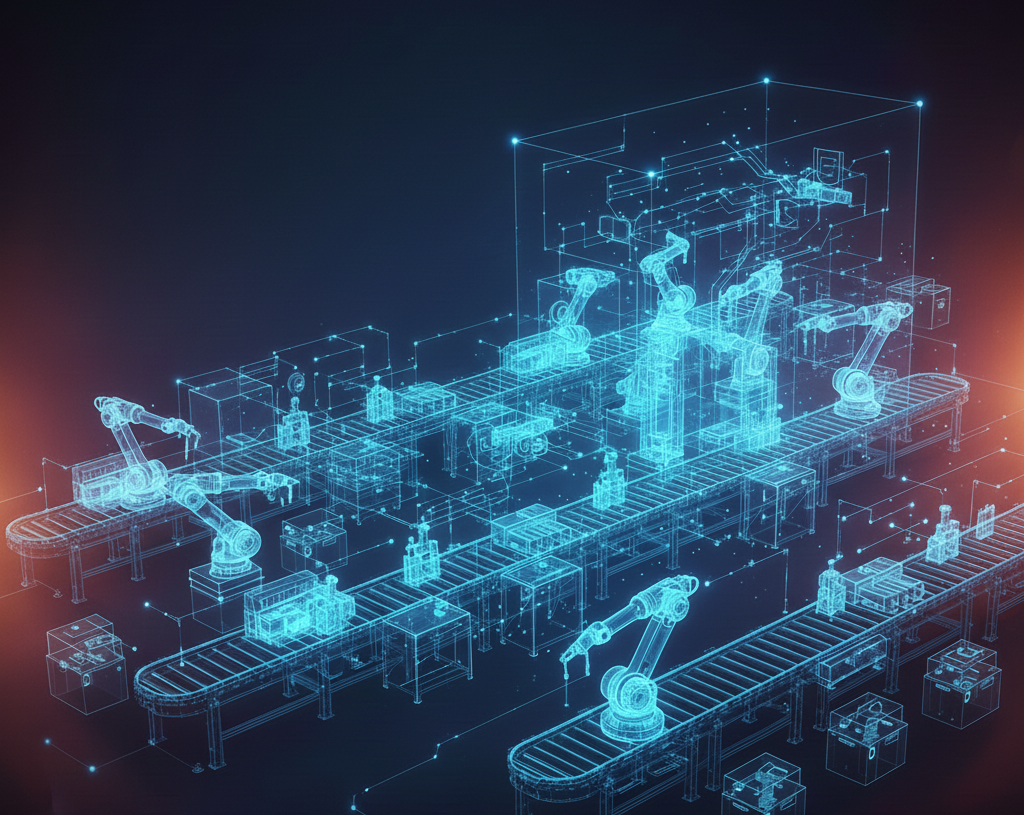
How Digital twins (virtual replicas) are reshaping production, engineering, and operational resilience.
Digital twins have moved from an aspirational buzzword to core operational technology inside modern factories. Once used primarily for visualization, they now serve as real-time decision engines, synchronizing data from machines, sensors, and production systems to create virtual replicas that behave exactly like their physical counterparts. As manufacturers face pressures from labor shortages, rising quality expectations, and volatile supply chains, digital twins provide something uniquely valuable: the ability to test, optimize, and predict outcomes without interrupting production. The result is faster commissioning, fewer breakdowns, and higher throughput—delivering ROI that is both measurable and rapid.
Further reading: Smart Manufacturing: Market Outlook 2026
How Digital Twins Actually Work

At the heart of a digital twin is the continuous feedback loop between the real and virtual world. Sensors and PLC/SCADA systems feed operating data into a simulation model, which runs on cloud or edge computing platforms. AI and machine-learning models analyze patterns, detect anomalies, and suggest optimizations. The digital twin then “acts back” on the physical process—adjusting parameters or providing recommendations to operators.
The combination of physics-based simulation, discrete-event modeling, real-time IoT data, and AI analytics makes digital twins far more powerful than earlier static simulation tools.
Process Optimization: The Everyday Use Case With Outsized Impact
One of the most widely adopted applications is process optimization. By modeling the entire production line, manufacturers can see exactly where bottlenecks, inefficiencies, or imbalances occur. This allows engineers to experiment with solutions in the virtual model before making changes in the real plant.
Energy consumption can also be optimized by simulating peak loads, idle behavior, and machine utilization. Some factories have used twins to cut energy costs through intelligent scheduling and load balancing—without compromising efficiency.
Material flow, labor allocation, and even factory layout decisions increasingly rely on digital simulations to ensure the highest possible efficiency.
Virtual Commissioning: Faster Ramp-Up, Fewer Errors

Traditional commissioning often involves lengthy on-site debugging, costly rework, and unexpected delays. Digital twins radically change this equation.
Through virtual commissioning, manufacturers can test PLC logic, robot paths, safety zones, and cell interactions long before equipment arrives on the plant floor. Collisions, timing conflicts, and cycle-time imbalances are identified early, preventing costly reengineering later.
Robotics integrators routinely report 30-50% reductions in commissioning time because software testing and validation occur in parallel with physical installation. This dramatically shortens time-to-production for new lines or major upgrades.
Further reading: Why Japan’s Manufacturing DNA Matters in the Global Industry 4.0 Race
Predictive Maintenance and Failure Scenario Simulation
When combined with condition-monitoring data and AI models, digital twins become powerful predictive maintenance tools.
They can estimate the remaining useful life of motors, drives, actuators, and robotic joints, allowing factories to schedule repairs at optimal times rather than responding to breakdowns. Instead of generic maintenance intervals, service becomes entirely data-driven.
Even more importantly, digital twins allow manufacturers to simulate rare or dangerous events—thermal overloads, pressure failures, hydraulic issues, or system interactions that would be unsafe to test physically. These “what-if” scenarios help engineers build more robust systems and avoid catastrophic downtime.
In industries like semiconductors, where a single hour of downtime can cost millions, this capability is transformative.
Further reading: Predictive Maintenance: The Data-Driven Solution to Industrial Downtime
Digital Twins in Quality Control and Product Lifecycle Engineering
Quality control is shifting from a reactive process to a closed-loop, real-time system enabled by digital twins. Vision systems and sensors feed defect data into the twin, which analyzes patterns and adjusts process parameters instantly.
The twin may detect subtle drifts in alignment, temperature, or vibration before defects appear—improving first-pass yield and reducing scrap.
More advanced manufacturing and after-sales service. This continuity allows teams to predict warranty issues, improve future designs, and optimize long-term reliability.
The ROI: Why Digital Twins Pay for Themselves

Digital twins provide a rare combination: strategic value + fast financial returns. Key ROI drivers include:
Reduced Downtime
Predictive insights prevent unplanned stoppages, cutting losses that can exceed tens of thousands of dollars per hour.
Faster Ramp-Up
Virtual commissioning reduces time-to-production for new lines, saving weeks of engineering resources and accelerating revenue.
Higher Quality and Less Scrap
Closed-loop quality control reduces defects, rework, and waste—boosting customer satisfaction and lowering internal costs.
Better Capital Planning
Simulation-backed decisions minimize the risk of over-investing or undersizing new equipment or expansions.
Most manufacturers recover their investment in digital twin platforms within 6 to 18 months, depending on the complexity of the system.
Barriers to Adoption: The Challenges That Remain

Despite rapid growth, digital twin adoption still faces hurdles. Many manufacturers struggle with aging equipment that cannot easily provide real-time data. legacy systems and soiled software also make integration difficult. There is a noticeable skills gap: simulation expertise, OT knowledge, and AI capabilities rarely exist in a single team.
Scalability is another hurdle. Creating a twin of a single machine is easy; creating one for an entire plant or global supply chain requires more advanced architecture and governance.
The Future: Toward Self-Optimizing Factories
As AI agents, edge computing, and real-time orchestration technologies mature, digital twins will evolve from advisory tools to autonomous optimization systems.
Factories will run with continuously updated simulation layers, automatically adjusting cycle times, material routing, energy use, and maintenance schedules. Supply chains will use twins for risk forecasting, dynamic planning, and resilience modeling. Ultimately, digital twins will help create factories that learn, adapt, and correct themselves at scale.
Digital Twins Are Becoming the New Manufacturing Playbook

What started as a visualization technology is now one of the most important components of modern industrial strategy. Digital twins combine data, simulation, AI, and operational feedback to create factories that are more efficient, more resilient, and more predictable.
For manufacturers navigating global competition, labor constraints, and quality demands, digital twins are no longer optional—they are becoming the default blueprint for how modern production should operate. The companies that adopt them now will define the next generation of industrial competitiveness.
Further reading: Society 5.0 in Practice: What Japanese Manufacturers Are Doing


