


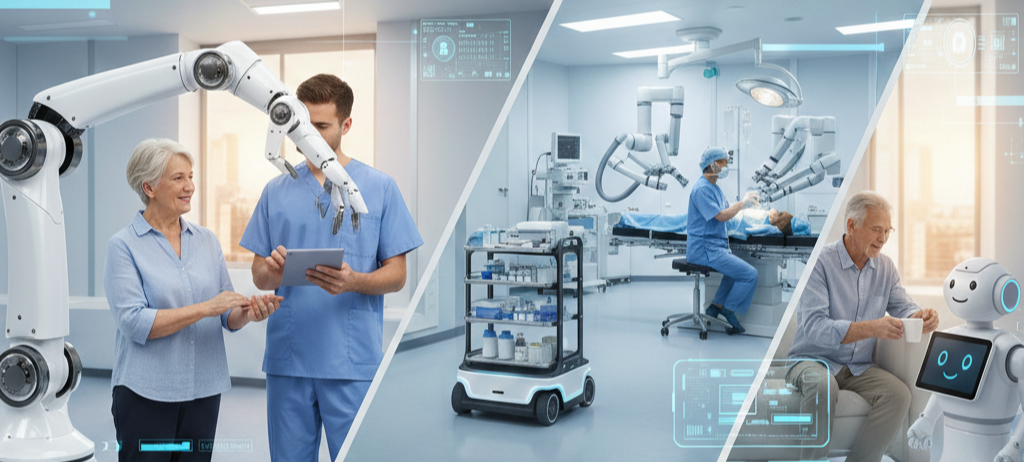
Healthcare systems across Western countries are under pressure. Aging populations, staff shortages, rising costs, and growing patient expectations are forcing hospitals and care providers to innovate. One of the most powerful forces driving that transformation is robotics in healthcare.
Once limited to highly specialized surgical suites, medical robots are now assisting in rehabilitation, hospital logistics, and even elder care at home. Importantly, these technologies are not replacing healthcare professionals; they are augmenting them, increasing precision, reducing burnout, and improving patient outcomes.
Here’s how robotics is reshaping healthcare across the United States, Europe, and other Western markets.
Further reading: Collaborative Robots (Cobots): The New Face of Human–Machine Partnership
The Rise of Surgical Robotics in Healthcare

Surgical robotics is often the first thing people think of when discussing medical robots—and for good reason. It represents one of the most mature and commercially successful segments of healthcare robotics.
From Assistive Tools to Advanced Platforms
Modern robotic surgery platforms, such as the da Vinci Surgical System, allow surgeons to perform minimally invasive procedures with enhanced precision and visualization. Instead of large incisions, surgeons operate through small ports, controlling robotic arms equipped with micro-instruments.
In the United States, robotic-assisted surgery has become increasingly common in urology, gynecology, and general surgery. European hospitals are also expanding robotic surgery programs, particularly in Germany, France, and the UK.
Benefits for Patients
Robotic-assisted procedures often result in:
- Smaller incisions
- Reduced blood loss
- Lower risk of infection
- Shorter hospital stays
- Faster recovery times
For Western healthcare systems focused on reducing readmissions and improving outcomes, these advantages are significant. Shorter hospital stays mean lower costs and increased bed availability.
Limitations & Cost Considerations
However, robotic surgical systems are expensive—often costing millions of dollars, plus ongoing maintenance and training. Smaller hospitals and rural healthcare facilities may struggle to justify the investment.
As competition grows and newer systems enter the market, pricing pressure may make surgical robotics more accessible over the next decade.
Robotics in Healthcare: Rehabilitation & Physical Therapy
Beyond the operating room, robotics is transforming how patients recover from injury or neurological events such as strokes.
Exoskeletons and Mobility Support
Robotic exoskeletons are wearable devices that assist patients in standing, walking, and rebuilding muscle memory. Systems like the EksoNR are already used in rehabilitation centers across North America and Europe.
For patients recovering from spinal cord injuries or stroke, exoskeleton-assisted therapy can:
- Increase repetition and consistency of movement
- Improve gait training
- Support earlier mobility
- Boost psychological confidence
With aging Western populations and rising stroke incidence, robotic rehabilitation tools offer scalable therapy solutions when physical therapists are in short supply.
Data-Driven Therapy
One major advantage of robotic rehabilitation systems is data collection. These devices track range of motion, strength, speed, and improvement trends. That data helps clinicians personalize therapy plans and demonstrate measurable progress to insurers—a critical factor in U.S. reimbursement systems.
Robotics in Elder Care: Supporting Aging Populations

Western countries are facing a demographic shift. In the U.S., UK, and much of Europe, the population aged 65 and over is growing rapidly. At the same time, caregiver shortages are becoming acute.
Robotics offers partial solutions.
Companion & Assistance Robots
Robotic companions are being used in nursing homes and assisted living facilities to reduce loneliness and support emotional well-being. One example is PARO, a therapeutic robotic seal designed to provide comfort to dementia patients.
In addition to companionship, elder care robots can:
- Remind patients to take medication
- Monitor vital signs
- Detect falls
- Provide emergency alerts
- Facilitate video calls with family
These systems are particularly appealing in Western countries where seniors often live independently or in smaller family units.
Ethical & Social Considerations
While robotics can improve safety and reduce caregiver strain, ethical questions remain:
- Should robots replace human interaction?
- How is patient data protected?
- Are vulnerable populations being over-monitored?
Healthcare systems in Europe, particularly under GDPR regulations, must carefully balance innovation with privacy protection.
The key trend is not replacement—it is supplementation. Robots handle repetitive or monitoring tasks so caregivers can focus on empathy and complex care.
Hospital Logistics & Automation
Not all healthcare robots interact directly with patients. Some operate quietly in the background—but their impact is significant.
Autonomous Delivery Robots in Healthcare
In large Western hospitals, staff spend substantial time transporting supplies, medication, lab samples, and linens. Autonomous mobile robots now handle many of these repetitive logistics tasks.
Benefits include:
- Reduced staff workload
- Fewer interruptions for nurses
- Improved workflow efficiency
- Lower risk of contamination
Infection Control & Disinfection
After the COVID-19 pandemic, hospitals in the U.S. and Europe accelerated investment in automated disinfection systems. Robots like LightStrike use UV light to reduce pathogens in hospital rooms.
Infection control has become a top priority for Western healthcare providers, and robotics plays a growing role in preventing hospital-acquired infections (HAIs).
The Role of AI in Healthcare Robotics

Robotics does not operate in isolation. Artificial intelligence is increasingly integrated into robotic systems to improve:
- Image recognition during surgery
- Predictive maintenance of equipment
- Real-time decision support
- Personalized rehabilitation programs
In Western markets, AI regulation and clinical validation are crucial. Systems must meet FDA standards in the United States or CE marking requirements in Europe.
As AI models improve, robotic systems may become semi-autonomous in limited contexts—though full autonomy in surgery remains a long-term possibility rather than an immediate reality.
Economic Impact of Western Healthcare Systems
Healthcare spending accounts for a large percentage of GDP in the U.S. and a significant share in European nations. Robotics presents both a cost challenge and a cost-saving opportunity.
Robotics in Healthcare: Short-Term Investment, Long-Term Savings?
Initial investment in robotics is high. However, potential long-term savings include:
- Reduced surgical complications
- Lower readmission rates
- Shorter recovery periods
- Decreased labor strain
- Increased operational efficiency
For Western countries facing nurse shortages and burnout, robotics may help stabilize workforce pressure rather than eliminate jobs.
Barriers to Widespread Adoption
Despite momentum, several barriers remain:
- High capital costs
- Training requirements for clinicians
- Regulatory hurdles
- Cybersecurity risks
- Unequal access between urban and rural hospitals
In the United States, reimbursement models strongly influence adoption. In Europe, public healthcare budgeting cycles can slow implementation.
Addressing these barriers will determine how rapidly robotics becomes standard practice rather than premium technology.
The Future of Robotics in Healthcare

Looking ahead, several trends are shaping the next phase of healthcare robotics in Western countries:
Remote Robotic Surgery
Tele-operated robotic surgery could expand access to specialized care in rural regions. Surgeons in major urban hospitals may one day operate on patients hundreds of miles away.
Micro- and Nano-Robotics
Research institutions are exploring microscopic robots that could deliver drugs directly to tumors or perform internal diagnostics.
Home Healthcare Robotics
As healthcare shifts toward outpatient and home-based care models, robotics will likely expand into remote monitoring and at-home rehabilitation systems.
The next decade will likely focus on integration—combining robotics, AI, telemedicine, and data analytics into unified healthcare ecosystems.
Robotics in Healthcare Summary
Robotics in healthcare is no longer futuristic speculation. It is already transforming surgery, rehabilitation, hospital logistics, and elder care across Western countries.
While challenges remain—particularly around cost, regulation, and ethics—the trajectory is clear. Robotics is enhancing clinical precision, supporting overburdened healthcare workers, and improving patient outcomes.
Rather than replacing human professionals, robots are becoming collaborative tools—extending the capabilities of doctors, nurses, and caregivers in meaningful ways.
Healthcare in the West is evolving. Robotics is one technology leading the change.
Further reading: Can Robot Companions Conquer Loneliness?


