


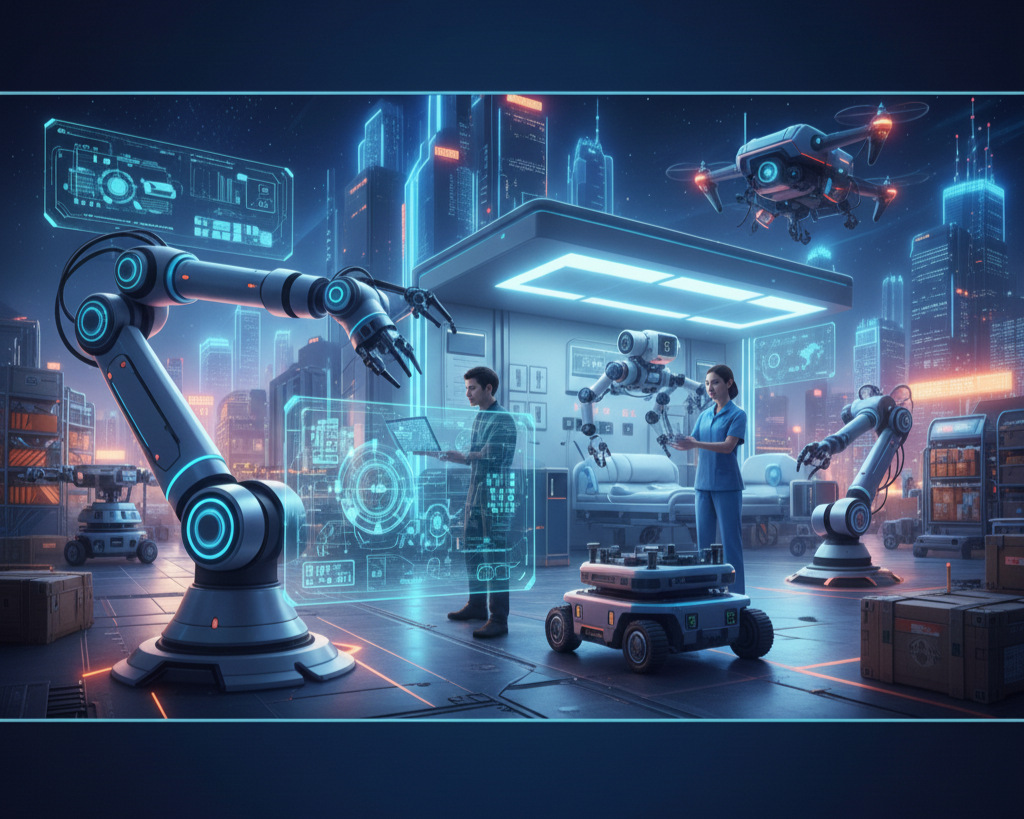
Robotics in 2025: The Technologies Transforming Automation, Productivity, and Work
Robotics is no longer an emerging technology—it is a competitive necessity. In 2025, advances in artificial intelligence, collaborative systems, mobile autonomy, and distributed computing are pushing robots out of controlled pilot environments and into full-scale operations. Manufacturers, logistics providers, healthcare systems, and service industries are accelerating adoption not just to cut costs, but to solve labor shortages, increase flexibility, and improve resilience.
The most important shift? Robots are becoming smarter, more mobile, and easier to deploy, enabling automation at a scale and speed that wasn’t possible even a few years ago.
Further reading: Smart Manufacturing: Market Outlook 2026
AI-Powered Robotics Moves from Promise to Production

Artificial intelligence is the engine driving nearly every major robotics breakthrough in 2025. Traditional robots followed pre-programmed instructions, making them efficient but inflexible. Today’s AI-enabled robots can perceive their surroundings, learn from data, and adapt to changing conditions.
Computer vision allows robots to identify objects with far greater accuracy, while machine learning helps them improve performance over time. Natural language interfaces and high-level task planning further reduce the complexity of deployment, enabling operators to configure systems without deep programming expertise.
AI dramatically reduces setup time and increases robot utilization. For businesses, this translates into faster ROI, higher throughput, and automation that can handle product variation instead of avoiding it.
Cobots Become True Teammates on the Factory Floor
Collaborative robots, or cobots, have evolved beyond their early role as slow, safety-focused machines. In 2025, cobots are faster, more dexterous, and far more aware of human presence thanks to advanced sensors and vision systems.
These robots are increasingly deployed in environments where flexibility matters most—assembly lines, packaging operations, and custom manufacturing. Instead of replacing workers, cobots handle repetitive or ergonomically challenging tasks while humans focus on quality, problem-solving, and oversight.
Cobots lower the barrier to automation, especially for small and mid-sized companies. They require less infrastructure, cost less to deploy, and adapt quickly to changing production needs—making them ideal for high-mix, low-volume environments.
Further reading: Collaborative Robots (Cobots): The New Face of Human–Machine Partnership
Autonomous Mobile Robots Redefine Material Handling

Autonomous Mobile Robots (AMRs) are rapidly replacing fixed-path automated guided vehicles (AGVs). Unlike AGVs, AMRs use sensors, mapping, and real-time decision-making to navigate dynamic environments without physical guides or predefined routes.
In 2025, AMRs will become central to warehouse and factory operations. They move materials between workstations, deliver components just in time, and adapt instantly when layouts or workflows change.
AMRs enable scalable automation. Businesses can add or redeploy robots as demand shifts, without costly facility redesigns. This flexibility is critical in industries facing volatile supply chains and fluctuating order volumes.
Edge Computing Brings Intelligence Closer to the Robot
As robots become more autonomous, the need for fast, reliable decision-making grows. Edge computing addresses this challenge by processing data directly on the robot or nearby devices rather than relying solely on cloud infrastructure.
By keeping computation close to the machine, robots can respond in milliseconds—essential for safety systems, vision-based inspection, and navigation. Edge computing also improves reliability in environments with limited connectivity and reduces data transfer costs.
Edge-enabled robots are safer, faster, and more resilient. In 2025, edge computing is no longer optional—it’s foundational to deploying robotics at scale in real-world industrial environments.
Swarm Robotics Moves Toward Practical Deployment

Swarm robotics, inspired by collective behavior in nature, involves multiple robots working together as a coordinated system. While long confined to research labs, swarm concepts are beginning to see real-world applications in 2025.
In logistics, fleets of simple robots coordinate tasks dynamically. In agriculture and environmental monitoring, swarms cover large areas efficiently and continue operating even if individual units fail.
Swarm systems offer scalability and fault tolerance. Instead of relying on one complex robot, organizations can deploy many smaller units that adapt as a group—reducing risk and increasing operational flexibility.
Software Platforms and Interoperability Take Center Stage
As robot fleets grow, managing them becomes as important as the hardware itself. In 2025, unified robotics software platforms are emerging to coordinate multiple robot types, manage updates, and integrate with enterprise systems.
Open standards and APIs are gaining traction, reducing vendor lock-in and enabling companies to build automation ecosystems instead of isolated solutions.
Interoperability accelerates scaling. Companies can deploy robots across multiple sites, integrate new technologies faster, and avoid costly system fragmentation.
The Workforce Evolves Alongside Robotics
Robotics adoption is reshaping the workforce—not eliminating it. As robots take on repetitive and hazardous tasks, human roles are shifting toward supervision, optimization, maintenance, and data-driven decision-making.
In 2025, demand is rising for technicians, system integrators, and operators who understand both robotics and AI-enabled systems. Organizations that invest in training and reskilling are seeing smoother adoption and higher returns.
Successful robotics strategies align technology with people. Workforce readiness is now a critical factor in automation ROI.
Preparing for the Robotics-Driven Future

The robotics trends that shaped 2025 point to one clear reality: automation is becoming smarter, more flexible, and more accessible. AI, cobots, AMRs, edge computing, and swarm systems are no longer niche innovations—they are defining how modern operations compete and scale.
Companies that embrace these technologies early, invest in interoperable platforms, and prioritize workforce development will be best positioned to thrive in an increasingly automated world.
Further reading: Vision Systems in Robotics: Seeing is Believing


