


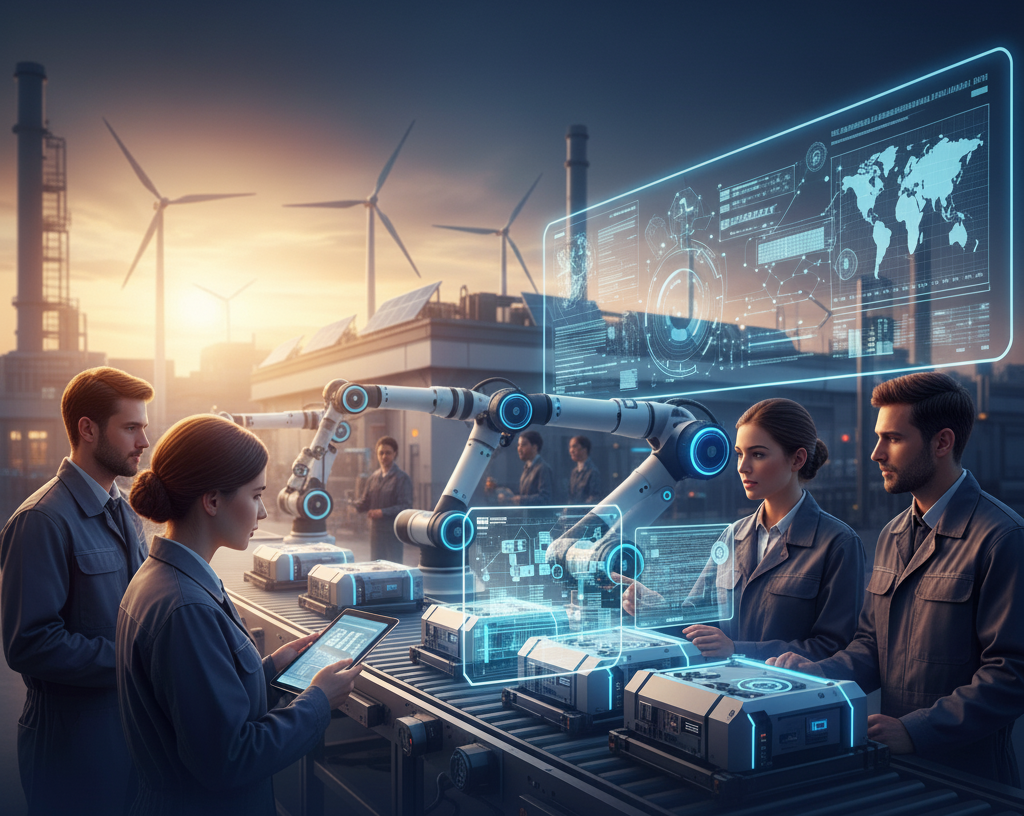
Spotlight on new companies transforming production models
Industrial technology is undergoing a rapid shift, driven not just by major OEMs and multinational corporations but by a rising wave of startups entering the once slow-moving manufacturing sector. Historically, factory transformation took years and required heavy capital investment. But today, digital tools and scalable computing have changed the dynamics. Industry 4.0 is being accelerated by a new class of companies capable of delivering transformative results at startup speed.
Several macro forces are fueling this shift: aging workforces, global labor shortages, the reshoring of production, efficiency pressure, sustainability mandates, and the mainstreaming of AI and industrial IoT. Manufacturers now face the same digital urgency that disrupted finance, media, retail, and logistics a decade earlier—and startups are positioned as the most agile drivers of that change.
Why Startups Can Move Faster Than Legacy Industry Leaders

Major industrial companies carry decades of operational complexity—old machines, legacy IT systems, and established cultures. Startups, by contrast, benefit from clean slates.
Lean Structures and Rapid Decision Cycles
A company with fewer than 50 employees can pivot, redesign, and deploy solutions in weeks—not quarters. This agility enables rapid prototyping, tight user feedback loops, and faster real-world validation.
No Legacy Footprint to Constrain Innovation
Large companies must modernize while keeping production running, often dealing with decades-old machines and proprietary software. Startups build directly for modern systems—from cloud-native architectures to modular robotics—without carrying the weight of legacy infrastructure.
Talent in Emerging Technologies
Industrial transformation today is not just mechanical—it is computational. Startups are staffed with AI scientists, robotics engineers, and data specialists capable of solving factory problems algorithmically. The result is not incremental automation, but new digital production models that would have been unrealistic 20 years ago.
Where Startups Are Disrupting Industrial Tech

From predictive analytics to robotics and sustainability, startups are pushing forward key capabilities that define Industry 4.0.
AI and Advanced Industrial Analytics
Manufacturing produces vast datasets—temperature readings, vibration patterns, quality metrics, scheduling logs—but legacy systems rarely exploit this information at scale. AI startups are:
- Using real-time analytics to optimize output
- Predicting equipment failures before they occur
- Modeling production schedules based on historical performance
- Detecting defects and quality anomalies faster than human inspection
These solutions turn factory data into cost savings, improved uptime, and measurable productivity gains.
Robotics and Human-Machine Collaboration
Industrial robotics is no longer the exclusive domain of multi-million-dollar automotive lines. Startups are making automation accessible to smaller factories through:
- Collaborative robots (cobots) that work safely next to humans
- Autonomous Mobile Robots (AMRs) that move material between stations
- Modular plug-and-play systems that require minimal integration
This democratization of automation lets even small and medium manufacturers compete at global performance levels.
Digital Twins and Simulation Platforms
Startups building digital twin environments allow factories to test production changes virtually before implementing them physically. Benefits include:
- Faster production ramp-up
- Reduced risk during process changes
- Lower engineering and prototyping costs
- Optimization without shutting down lines
In sections like electronics and automotive, virtual commissioning can cut lead times from months to weeks.
Predictive Maintenance and Reliability Platforms
Modern predictive maintenance platforms use:
- Embedded sensors
- Vibration and thermal monitoring
- Cloud analytics
- Machine learning algorithms
To forecast equipment failure and reduce downtime. Many startups now offer this as a subscription model—allowing manufacturers to shift maintenance from a cost center to a performance-driven service.
Sustainability and Energy Efficiency
ESG pressure and global regulation are amplifying demand for:
- Energy-efficient production
- Low-waste manufacturing
- Carbon-tracked supply chain
Startups are building real-time sustainability dashboards, optimized material flow systems, and tools that help factories reduce waste—and prove it with transparent data.
Startup Case Studies: New Players Defining the Next Factory Model

While the industrial startup landscape varies by region, several success patterns have emerged.
Case Study 1: AI-Driven Factory Intelligence
A startup offering machine-learning-based production optimization deployed its systems in two mid-scale electronics plants. By analyzing sensor data and historical logs, the system automatically recommended adjustments to scheduling and operating parameters. The result:
- 12% reduction in downtime
- 9% increase in throughput
- Improved consistency with fewer process bottlenecks
What once required expert engineering analysis is now delivered in real time, 24/7, by intelligent software.
Case Study 2: Affordable Robotics for SMEs
A robotics startup specializing in cobots created a deployment model that requires no programming experience. Operators train the robot by guiding its arm manually, and the system learns the workflow using embedded sensors. Within weeks:
- A machine shop automated repetitive inspection tasks
- Operators transitioned to higher-value work
- Payback time dropped to under six months
This is what democratized robotics looks like—small factories finally gaining access to automation previously reserved for automotive giants.
Case Study 3: Digital Twin Deployment in Manufacturing
Another startup offers digital twin solutions that allow detailed layout and process simulation for new production lines. Instead of waiting months to commission new equipment, users run virtual tests, validate throughout, and identify bottlenecks before a single machine arrives. One factory cut deployment time from 16 weeks to 6, saving both capital and production losses.
Further reading: Consumer Robotics: Solutions You Can Use Today
How Startups Are Transforming Production Models

Beyond incremental improvements, startups are redefining how factories invest, scale, and operate.
Automation-as-a-Service
Instead of six-figure capital purchases, “manufacturing as subscription” models enable low upfront cost, ongoing support, continuous improvement, and ROI linked directly to uptime or output. This shifts automation from a one-time equipment purchase into a data-driven performance service.
Flexible and Modular Systems
Traditional factories were designed around long product life cycles. Today’s startups build solutions that reconfigure fast, deploy in smaller footprints, and scale in digital increments rather than floor space. Production becomes elastic—not fixed.
Manufacturing is Becoming Software-Defined
In the next decade, operators will increasingly manage processes not through physical tweaking but through AI recommendations, digital dashboards, algorithmic early warnings, and remote supervisory control. Knowledge is moving from human intuition into models and code.
The Challenges Startups Still Face

Innovation speed doesn’t eliminate the realities of industrial adoption.
Long Sales Cycles
Manufacturers are traditionally conservative and highly risk-averse, which means sales cycles in industrial tech can be significantly longer than in typical software markets. Even when a startup’s solution shows clear value in pilot projects, equipment decisions often require multiple approval layers—from engineering and maintenance teams to finance, procurement, and executive leadership.
In many cases, the process includes factory trials, vendor qualification, compliance checks, and return-on-investment modeling before a contract is signed. As a result, converting a lead into a deployment can take 6 to 18 months or more. This slow pace can strain young companies that need revenue to support growth, and it forces industrial startups to build a strong financial runway and patient go-to-market strategies.
Legacy Environment Integration
Factories often run a mix of:
- 1980s CNC machines
- On-premise PLC systems
- New IIoT data services
Startups must build tools that interface with decades of industrial technology rather than replace it outright.
Performance at an Industrial Scale
Even the most elegant prototype must prove it can withstand real factory conditions. Industrial environments demand high uptime, resilience in harsh operating conditions, and the ability to perform under continuous high duty cycles.
Solutions must also demonstrate clear economic justification, not just technical promise. This phase is often where startups face their toughest test, as both funding and patience are challenged by the realities of scaling technology for industrial use.
The Future: Startups as the Catalyst of Industry 4.0

Big industry players are beginning to recognize that startups are not competitors—they are accelerators. Increasingly, major manufacturers are investing in or acquiring startups to supplement internal R&D capabilities. Meanwhile, industrial ecosystems are moving toward open standards and interoperable APIs, making integration easier than ever before.
The result is a manufacturing landscape that is shifting from mechanical to digital, from rigid to adaptive, and from analog optimization to algorithmic intelligence. Startups are not merely adding tools to the factory—they are redefining how factories operate, scale, and compete.
A New Industrial Vanguard
Startups are proving that industrial innovation no longer needs to be slow or capital-intensive. Through AI, robotics, digital simulation, data analytics, and new business models, they are modernizing production at a pace legacy manufacturers cannot match alone. As Industry 4.0 continues to expand, the factories that embrace startup-driven innovation will lead the next era of global manufacturing competitiveness.


