


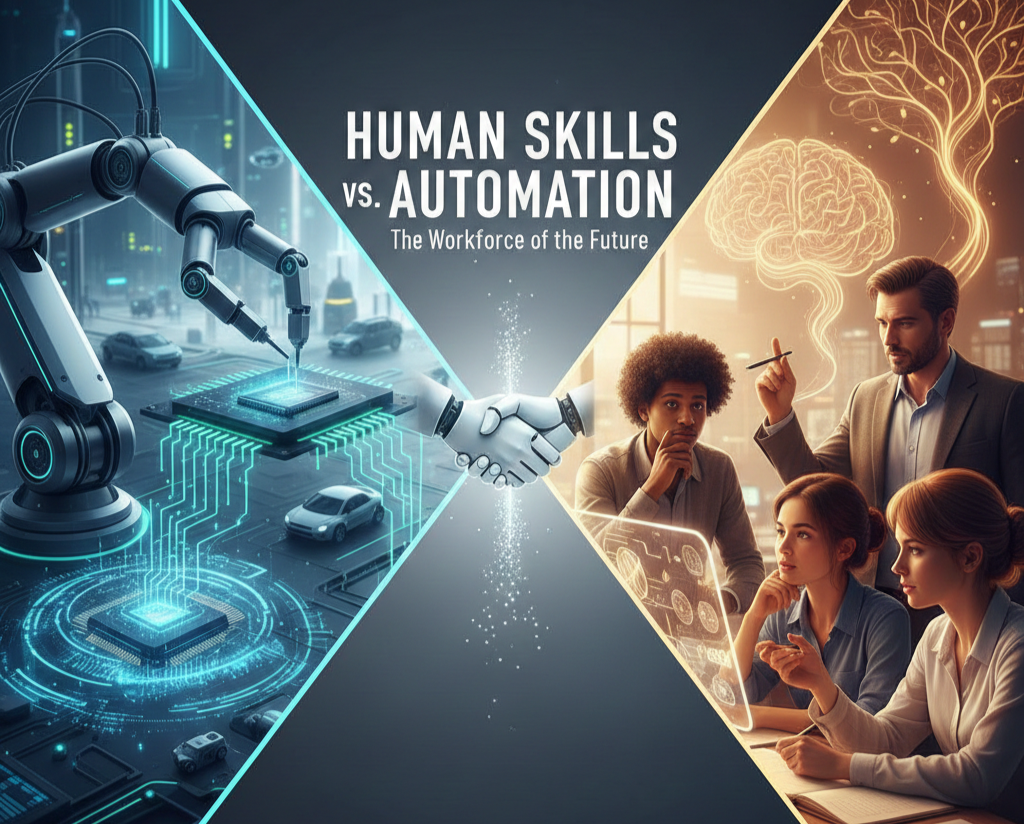
A thought-leadership look at reskilling, productivity, and the evolving human role in automated workplaces
Automation is accelerating across every industry. Robots are taking on precision work on factory floors, AI systems are powering quality checks and optimization, and autonomous platforms are handling logistics in ways once thought impossible. Yet even as automation becomes more capable, the human workforce is not becoming less relevant. It is becoming increasingly essential.
The future of work isn’t a tug-of-war between humans and machines—it is a shift toward mutual augmentation, where automation handles routine or hazardous tasks and people focus on creativity, judgment, leadership, and innovation. For business leaders, this transformation demands not only new technologies but a strategy for reskilling and rethinking workforce design.
Further reading: Smart Manufacturing: Market Outlook 2026
Why Automation Isn’t Replacing People—It’s Redefining Roles

Contrary to common fears, automation rarely eliminates jobs outright. Instead, it reshapes them. Tasks become automated, not entire roles. The result is a reallocation of human effort toward:
- Analytical and decision-making tasks
- Cross-disciplinary problem-solving
- Roles blending technical and interpersonal skills
- Oversight of automated systems
In manufacturing, for example, the robot that welds, paints, or transports materials still requires a human operator or technician who can manage exceptions, optimize performance, and solve edge-case issues. Automation shifts the human role from “doing the work” to orchestrating the work.
The winners in this new landscape will be companies that understand automation’s real promise: freeing people to do higher-value work—not replacing them.
Further reading: How Startups Are Driving Innovation in Industrial Tech
The New Skill Categories for the Automated Workplace
Future-ready organizations must prepare for a workforce shaped by three critical skill clusters.
1. Human-Centric Skills (Irreplaceable by AI)
These are the abilities robots and AI still cannot replicate at expert human levels:
- Critical thinking and complex reasoning
- Interpersonal communication and negotiation
- Creativity, storytelling, and design thinking
- Empathy, leadership, and people management
- Ethical and strategic judgment
These skills anchor the human advantage—and will only grow in value as automation increases.
2. Tech-Enabled Skills (Rising in Demand)
Even non-technical roles will require familiarity with digital tools. The most impactful competencies include:
- Robotics oversight and exception handling
- Human-machine collaboration workflows
- Data literacy and basic analytic fluency
- Ability to use AI copilots and automation assistants
- Understanding of cybersecurity and digital safety
Workers who can adapt to increasingly automated environments will become the backbone of productivity.
3. Deep Technical Skills (Specialized and Scarce)
As automation becomes more sophisticated, demand will rise for specialists in:
- Robotics engineering and maintenance
- Automation system integration
- AI model management and fine-tuning
- Industrial IoT and sensor network design
- Digital twins, simulation, and predictive modeling
These roles already face global talent shortages—making strategic training essential.
Further reading: Smart Factories 4.0: How AI and IoT Are Rewiring Global Manufacturing
Reskilling: The New Engine of Workforce Competitiveness

Automation forces organizations to abandon the “hire for skill, train for tasks” model. Instead, leaders must adopt a culture of continuous capability building.
Effective reskilling programs share several traits:
1. Workflow-Integrated Learning
Training isn’t an optional side activity. It happens in real time, driven by actual operational needs and paired with hands-on automation exposure.
2. Role Transition Pathways
Employees need a clear blueprint for how their jobs evolve. The most successful companies document:
- What tasks will be automated
- What new responsibilities will emerge
- What skills must employees develop
- How long will the transition take
- What support will be provided
Uncertainty—not automation—is what destabilizes the workforce.
3. Micro-Certifications and Targeted Upskilling
Short, modular programs (e.g., “Robot Operations Level 1,” “AI-Assisted Quality Control Certification,” “Digital Safety Basics”) help workers adapt step-by-step.
4. Cross-Functional Skills Mobility
In automated plants and logistics centers, boundaries blur. Workers increasingly shift between:
- Production
- Maintenance
- Quality
- Logistics
- Data operations
Workforces able to do this flexibly outperform competitors stuck in rigid role structures.
Productivity in the Automation Era: Augmentation, Not Replacement
The highest-performing organizations already operate under a new productivity model:
Automation provides capacity; humans provide intelligence.
Robots and AI scale speed, consistency, and data processing—while humans drive innovation, reasoning, and business outcomes.
What this looks like in practice:
- Humans diagnose why a process fails; automation handles how to fix repetitive issues.
- Automation analyzes thousands of parameters; humans choose priorities and trade-offs.
- Robots assemble; humans inspect, interpret, and improve.
- AI forecasts demand; humans design strategies and customer experiences.
This synergy produces a compounded productivity effect—a company-wide upgrade.
Further reading: Society 5.0 in Practice: What Japanese Manufacturers Are Doing
Leadership’s New Mandate: Build Human-Machine Teams

Executives must design workplaces where humans and automation operate as complementary partners. This requires:
1. Transparent Automation Strategy
Employees must understand not only what is being automated, but why and how it benefits them.
2. Cultural Alignment
Automation succeeds only when paired with trust, openness to experimentation, and a mindset of continuous learning.
3. High-Resolution Workforce Planning
Leaders must map roles, responsibilities, and talent flows with precision. In automated environments, the cost of skill gaps multiplies.
4. Investment in People Equal to Investment in Tech
Robots depreciate. Human capability compounds. A future-ready workforce is the ultimate competitive advantage.
The Human Role Is Not Shrinking—It’s Ascending
Automation doesn’t diminish human value; it elevates it.
The future workplace will depend on humans for:
- Setting direction
- Making judgment calls
- Designing systems
- Building relationships
- Leading teams
- Ensuring ethical and responsible use of automation
Robots and AI will handle tasks. Humans will handle meaning.
The organizations that thrive will be those that empower their workforce to grow alongside technology—not behind it.
A Future Built on Partnership, Not Replacement

Automation is not the enemy of workers. It is the catalyst for a more capable, more strategic, more human workforce. The companies that embrace this truth will redefine what productivity means. The workers who develop adaptive, tech-enabled, and human-centric skills will shape the next era of industry. And the future of work will belong not to the fastest machines—but to the smartest human-machine teams.
Further reading: Predictive Maintenance: The Data-Driven Solution to Industrial Downtime


