


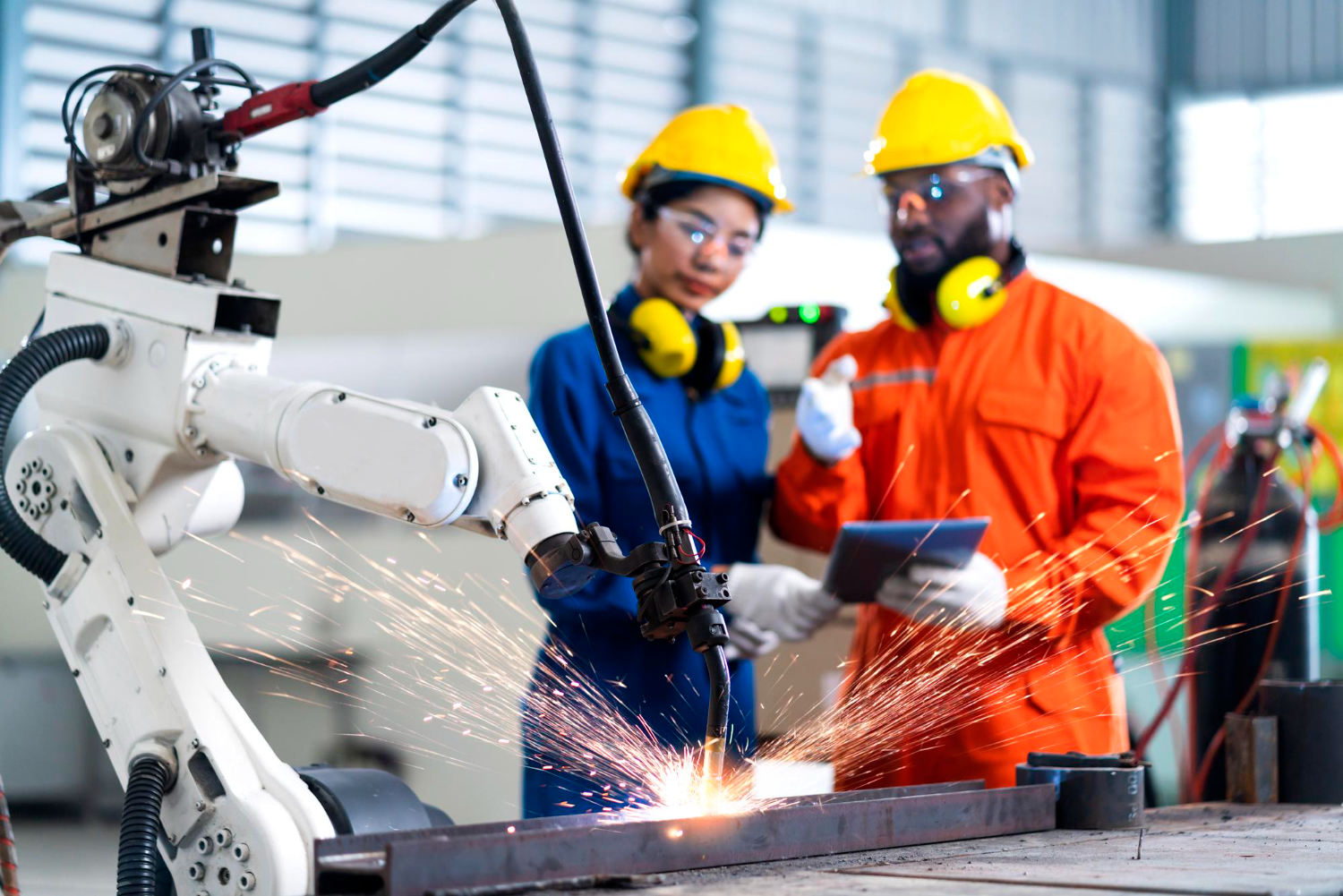
For decades, industrial workforce planning followed a predictable script: train workers on a specific machine, a specific line, a specific process, and expect that knowledge to remain relevant for the length of a career. That script no longer holds.
A wave of retirements is removing decades of institutional knowledge from factory floors, distribution centers, and plants at a pace that recruitment alone cannot replace. At the same time, the tools that those retiring workers once operated are supplemented. In some cases replaced by software-driven systems and robotics that require a different kind of fluency. The result is a structural shift in how companies think about labor. They think less about filling a headcount, more about building a workforce that can manage increasingly intelligent machines.
Further Reading: Why Industrial Companies Are Becoming Software Companies
The Retirement Cliff Is Real
Manufacturing and logistics have an age problem that has been building for years and is now arriving in full force. A significant share of the skilled industrial workforce falls within retirement age or close to it. These are workers who often accumulated their expertise over twenty or thirty years on the job. They frequently go through informal mentorship rather than formal documentation.
When that generation exits, it doesn’t just leave an empty seat. It leaves a knowledge gap that is difficult to quantify and even harder to backfill through conventional hiring. Younger entrants to the labor market are not arriving with the same hands-on experience — nor should companies expect them to.
This isn’t a temporary staffing shortfall to be solved with a hiring push. It’s a permanent shift in the skills profile required to run an industrial operation. It requires a permanent shift in how companies build their workforce.
From Recruitment to Reskilling
For much of the last century, industrial labor strategy centered on recruitment: find workers, train them on a task, and retain them as long as possible. That model is being replaced by one centered on continuous reskilling — treating the existing workforce as an asset to be developed.
This shift shows up in a few consistent patterns across companies that are managing the transition well.
Internal mobility is replacing external hiring as the first option
Rather than recruiting externally for every new technical role, companies are identifying employees with relevant aptitude. They often come from adjacent roles — and invest in structured training to move them into higher-skill positions. A machine operator with strong mechanical intuition may be a stronger investment as a technician than an external hire with no floor experience.
Training is shifting from one-time onboarding to a continuous curriculum
The old model trained a worker once and assumed durability. The new model treats technical skill as something that needs refreshing as new equipment is introduced. It’s closer to how technology companies approach engineering training than how factories traditionally approached labor.
Cross-functional fluency is becoming a baseline expectation
Workers are increasingly expected to understand not just their own equipment, but how it interacts with the broader system. The specialist-only model is giving way to a generalist-plus-specialty model.
What Upskilling Actually Looks Like on the Floor
Upskilling frameworks vary by company and sector, but the most effective ones share a few structural features.
Modular, role-specific training paths
Rather than generic technology training, leading programs map specific skill modules to specific roles. A forklift operator transitioning to oversee an AMR fleet needs a different curriculum than a quality inspector learning to interpret machine-vision defect reports.
Hands-on time with the actual systems
E-learning components are paired with supervised time monitoring of the software and machinery that the worker will eventually be responsible for. Simulation tools and digital twins are increasingly used to provide this exposure safely and at scale before workers touch live systems.
Certification and credentialing are built into career paths
Structured programs increasingly tie training completion to formal internal credentials. In some cases, external certifications — that are linked to pay grade advancement. This gives workers a visible, motivating path rather than open-ended “training for training’s sake.”
Mentorship pairing between retiring and incoming workers
Some of the most effective knowledge-transfer programs deliberately overlap a retiring specialist’s final months with a successor’s onboarding. They treat the transition period itself as a structured training asset rather than an afterthought.
The Software and Robotics Fluency Gap
As automation, robotics, and industrial software become standard fixtures, the skills gap has shifted from purely mechanical to increasingly digital.
Workers managing modern industrial environments are expected to interpret dashboards from fleet management software, understand basic diagnostic outputs from robotic systems, and know when an issue requires escalation. This doesn’t necessarily mean every floor worker needs to become a software engineer. It means basic technical literacy has become a core competency rather than a specialized one.
Companies that have moved early on this front often build tiered training: foundational digital literacy for the broad workforce. AS well as deeper technical specialization for workers moving into maintenance, integration, or systems-oversight roles. This tiered approach avoids over-investing in unnecessary depth for every worker.
Why This Matters for Competitiveness, Not Just Compliance
It’s tempting to treat upskilling as a defensive measure — something companies do to avoid a labor shortage crisis. But the operators getting this right are increasingly treating it as a competitive lever.
A workforce that understands the systems it operates can troubleshoot faster, reduce unplanned downtime, and adapt more quickly when new equipment or software is introduced. Retention also improves when workers see a structured path toward higher-skill, higher-pay roles rather than facing stagnation or displacement. In a labor market where skilled industrial talent is scarce, that retention advantage compounds over time.
The companies treating workforce restructuring purely as a cost center — minimal investment, reactive hiring, no internal development pathway — are the ones most exposed when the next wave of retirements or the next generation of automation arrives.
Frequently Asked Questions
Q: What is workforce restructuring in an industrial context?
It refers to the deliberate redesign of roles, training pathways, and skill requirements across a workforce — typically in response to technological change, demographic shifts (such as mass retirement), or both. It’s distinct from simple layoffs or hiring; the goal is to reshape what roles exist and what skills they require.
Q: How is upskilling different from traditional job training?
Traditional training is typically role-specific and one-time, aimed at getting a new hire competent in a fixed task. Upskilling is continuous and forward-looking, designed to expand a worker’s capability over time — often moving them toward higher-skill roles involving software, robotics oversight, or systems-level troubleshooting rather than a single repetitive task.
Q: How long does it typically take to upskill an existing worker into a higher-skill technical role?
This varies significantly by role complexity. Foundational digital literacy training can take weeks. Transitioning a worker into a specialized role — such as robotics maintenance technician or systems integration support — often takes several months to a year, particularly when combined with formal certification requirements.
Q: Can upskilling actually solve the retirement-driven labor gap, or does it just delay it?
Upskilling cannot fully replace decades of accumulated tacit knowledge from retiring specialists, but structured programs — particularly those that include direct mentorship overlap between outgoing and incoming workers — can meaningfully transfer critical operational knowledge before it’s lost. Combined with better documentation and digital knowledge capture, upskilling is one of the most effective tools available for narrowing the gap, even if it doesn’t eliminate it.
Q: Do workers actually want to be upskilled, or does this create resistance?
Resistance is more common when upskilling is framed as a threat to job security or imposed without input. Programs with the strongest worker buy-in tend to clearly link training to career advancement and pay growth, position workers as gaining capability rather than being replaced, and involve workers in decisions about which roles and skills to prioritize.
The Bottom Line
The retirement of a generation of skilled industrial workers was never going to be solved by recruitment alone — there simply aren’t enough new entrants with equivalent hands-on experience to replace what’s leaving. The companies adapting successfully are the ones treating their existing workforce as the primary asset to invest in, building structured pathways that combine mechanical know-how with the digital and robotics fluency the next generation of industrial systems demands.
This isn’t a short-term fix. It’s a permanent recalibration of what industrial labor strategy looks like — one where the most valuable workers aren’t necessarily the ones who know the most about a single machine, but the ones who can adapt as the machines, the software, and the systems around them keep evolving.
Continue Exploring: From Pilot to Scale: Why Industry 4.0 Projects Stall (and How to Fix It)


