


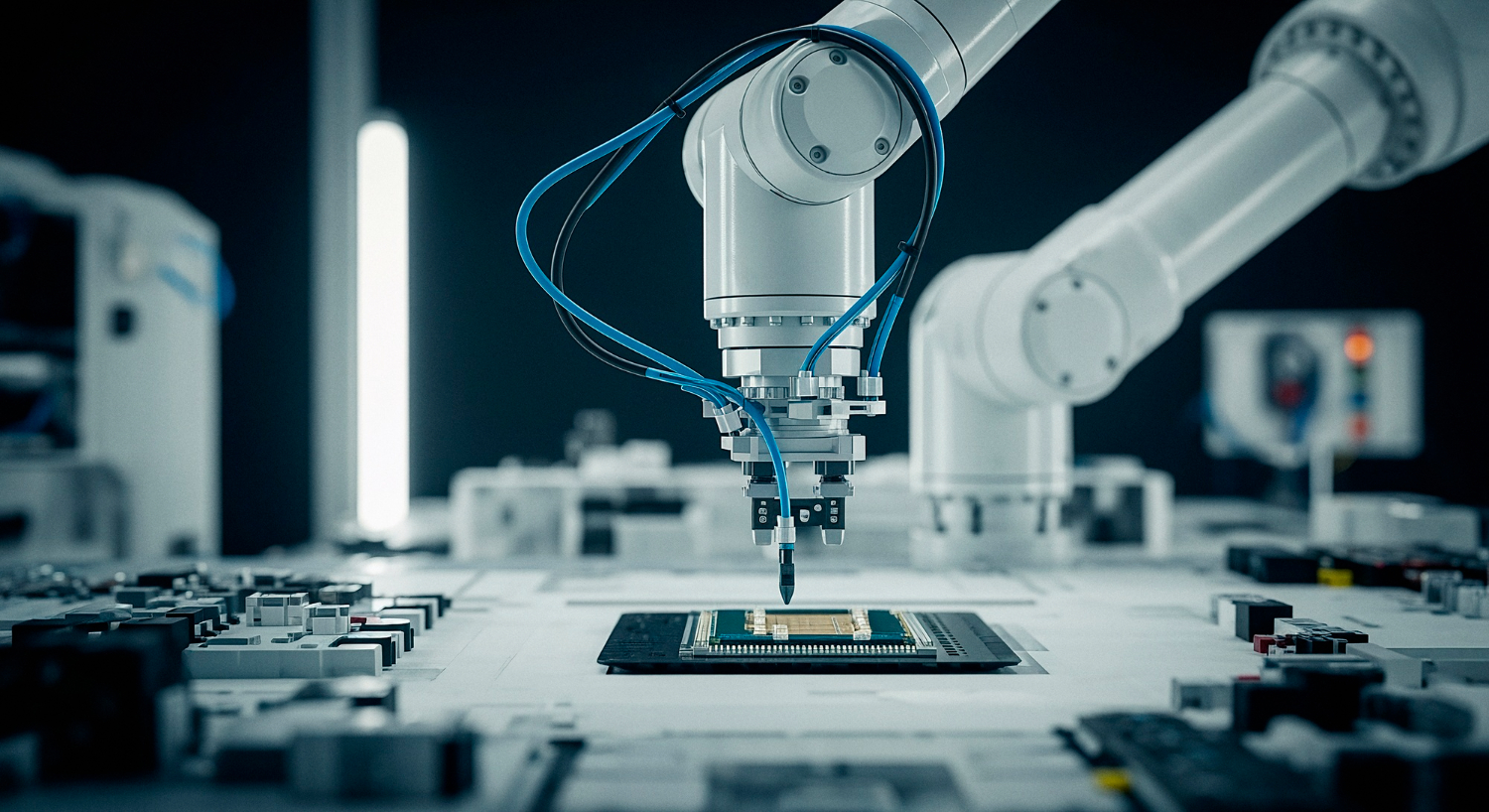
The artificial intelligence powering today’s robots is, by almost any measure, extraordinary. Modern robotic systems can identify objects in cluttered environments, plan multi-step sequences, learn from demonstration, and adapt to variations. The software has, in many respects, arrived.
And yet robots still can’t fold a T-shirt reliably. They struggle to pick a ripe tomato without bruising it, and they cannot unload a trailer of mixed, unlabeled boxes with anything approaching human speed or consistency. Their hands are either powerful or delicate, rarely both, and nowhere near as versatile as the five-fingered tool every human worker arrives with on day one.
The uncomfortable truth is that the software is ready for hardware that doesn’t yet exist. The bottleneck is no longer intelligence. It’s the physical machine.
Further Reading: Physical AI: What Does It Mean for Industrial Automation
The AI Narrative Has Run Ahead of the Hardware Reality
The past five years of robotics coverage have been dominated by AI breakthroughs. Large language models guiding robotic arms, reinforcement learning enabling robots to teach themselves manipulation skills in simulation, and foundation models that allow a single AI system to generalize across multiple robot platforms and tasks.
These developments are real and significant. But they have created a gap between the public perception of robotics capability and what is actually deployable.
AI gives a robot the ability to decide what to do. Hardware determines whether it can actually do it. And right now, the physical constraints are the limiting factor in almost every high-value robotic application that remains unsolved.
This is not a marginal problem. It is the central engineering challenge of the next decade of robotics, and the companies and research institutions that crack it will define the industry’s trajectory.
The Dexterity Problem Is a Hardware Problem
The most cited gap between robot and human capability is dexterity — the ability to manipulate objects with precision, adaptability, and appropriate force across an enormous variety of shapes, weights, textures, and conditions.
Human hands are a masterpiece of biological engineering. They contain 27 bones, 29 joints, more than 30 muscles, and a sensory system capable of detecting pressure, texture, temperature, and pain at a resolution no commercial sensor array has matched, switch seamlessly between power grip and precision grip, and handle a raw egg and a socket wrench with the same set of fingers.
Current robotic grippers and end effectors are improving — soft robotics has introduced compliant, adaptable fingers; parallel grippers have become faster and more reliable — but the gap remains wide. The problem is not that robots don’t know how to grasp an object. AI models can predict grasp points on novel objects with impressive accuracy. The problem is that the physical mechanism executing that grasp cannot yet match the feedback sensitivity and mechanical range of a human hand.
Solving this requires advances in soft actuator materials, tactile sensing embedded within gripper surfaces, and variable-stiffness mechanisms that shift between rigidity and compliance on demand. These are materials science and mechanical engineering challenges as much as they are computing challenges.
Actuators, Power, and the Weight-Endurance Trade-Off
Mobility presents a parallel constraint. Legged robots — the kind designed to navigate stairs, rough terrain, and environments built for humans — have made remarkable strides. But the engineering trade-offs involved remain severe.
The actuators that drive robotic limbs must be powerful enough to bear load, fast enough to respond dynamically, and light enough to carry without exhausting the power supply. Current electric motor technology is reaching practical limits in this three-way trade-off. Hydraulic systems offer power density advantages but introduce weight, complexity, and fluid management problems that limit deployment environments.
Battery technology is the other binding constraint. A humanoid robot performing physical labor at human-comparable intensity drains a battery pack in a fraction of the time a human worker sustains effort. The endurance gap is not a software problem — it’s an energy density problem that requires chemistry and materials breakthroughs, not better algorithms.
This explains why the most capable legged robots in demonstration settings often have conspicuously short untethered run times. The AI can navigate the terrain. The power system can’t sustain the mission.
Sensing Beyond Vision
Computer vision has matured into a genuinely reliable robotic tool. Cameras and LiDAR can map environments, identify objects, and track motion at accuracy rates that rival human visual processing.
But the physical world communicates in more than light. Temperature, pressure, surface texture, vibration, and force feedback all carry information that skilled human workers use constantly — often without consciously registering it. A technician tightening a bolt knows by feel when it’s seated correctly. A surgeon senses tissue resistance through an instrument. A baker judges dough by touch.
Replicating this sensory range in hardware is a frontier that computer vision alone cannot address. Research into skin-like tactile sensors, distributed pressure arrays, and embedded force-torque sensing is progressing, but the challenge of integrating dense sensing into a robust, washable, replaceable end effector that survives industrial use remains largely unsolved at the commercial scale.
Why This Creates the Next Wave of Investment Opportunity
The recognition that hardware is now the binding constraint has begun redirecting serious capital and research attention. Humanoid robot companies are not differentiated by their AI, which often draws on the same models as any well-funded team. They are differentiated by their mechanical architecture, actuator design, power systems, and manufacturing cost structures.
This is a meaningful shift. For years, robotics investment followed software logic: high margins, fast iteration, winner-take-all network effects. Hardware investment logic is different — slower, capital-intensive, dependent on manufacturing scale, and historically less attractive to venture capital. The companies that succeed in next-generation robotics hardware will likely look more like SpaceX or TSMC than like a software platform company.
That also creates genuine barriers to entry that pure-software robotics approaches don’t have. A better manipulation model can be replicated by a competitor with a large computing budget and the right team. A proprietary actuator with superior power density, developed through years of materials research and manufacturing iteration, is far harder to copy.
The Integration Challenge
It would be wrong to suggest AI and hardware are competing priorities — they are not. The path to capable general-purpose robots runs through both, and progress in one creates pull for progress in the other. As AI models become better at using imperfect sensory data and tolerating mechanical variance, they lower the threshold that hardware must meet. As hardware improves, it unlocks applications that the AI was theoretically ready for but practically couldn’t execute.
What has changed is the direction of the bottleneck. For much of the last decade, robotic hardware outpaced the AI needed to use it intelligently. Now the inverse is true. Closing that gap is the defining engineering problem of the next phase of robotics — and the solutions will come from materials scientists, mechanical engineers, and manufacturing innovators as much as from AI researchers.
Frequently Asked Questions
Q: If AI is so advanced, why can’t robots do simple physical tasks like folding laundry?
Folding laundry requires continuous dexterous manipulation of flexible, variable objects with no fixed shape — exactly the kind of task that exposes the limits of current hardware. The AI can understand the task and plan the sequence. Current end effectors lack the tactile sensitivity, mechanical range, and adaptive grip needed to execute it reliably on arbitrary fabric. It’s a hardware gap, not an intelligence gap.
Q: What is soft robotics, and why does it matter for dexterity?
Soft robotics is an approach that replaces mechanical components with flexible, compliant materials that deform and adapt. This makes grippers more forgiving when handling irregular shapes and reduces the risk of damaging fragile objects. It’s a promising direction for closing the dexterity gap, though durability and force transmission remain active engineering challenges.
Q: What are actuators, and why are they a bottleneck?
Actuators are the components that convert energy into mechanical movement — essentially the muscles of a robot. The challenge is that no current actuator technology delivers high power output, fast response, lighter weight, and long operational life in a package suitable for a mobile robot. Electric motors are the dominant technology but face physical limits. Next-generation actuators — including advanced electric designs, artificial muscles, and hybrid hydraulic-electric systems — are an active area of research and investment.
Q: Are humanoid robots the most practical form factor for industrial use?
Not necessarily, and the industry is divided on this. The argument for humanoids is that the physical world is designed around human proportions, so a robot can theoretically operate anywhere a person can. The counterargument is that purpose-built robotic systems outperform humanoids at specific industrial tasks and are available now at lower costs. Humanoids are likely to find their first commercial footholds in environments where task variety is high and retrofitting infrastructure is impractical.
Q: How far away are truly general-purpose robots from commercial deployment?
Honest estimates from leading researchers and engineers range from five to twenty years for robots capable of handling the full variety of physical tasks a human worker manages routinely. Near-term deployment will continue to focus on constrained, repeatable applications where the hardware requirements are achievable with current technology. The timeline for general-purpose capability depends heavily on breakthroughs in actuator design, tactile sensing, and energy storage — none of which are on a predictable schedule.
The Bottom Line
AI has given robots an unprecedented ability to perceive, reason, and plan. What it cannot do is compensate for a gripper that lacks feeling, an actuator that runs out of power, or a mechanical structure that fails under real-world conditions. The next chapter of robotics will be written not in lines of code, but in materials, mechanisms, and manufacturing.
The companies, researchers, and investors who direct their resources accordingly are positioning themselves at the actual frontier.
Continue Exploring: Why 2025 Was a Defining Year for Robotics


