


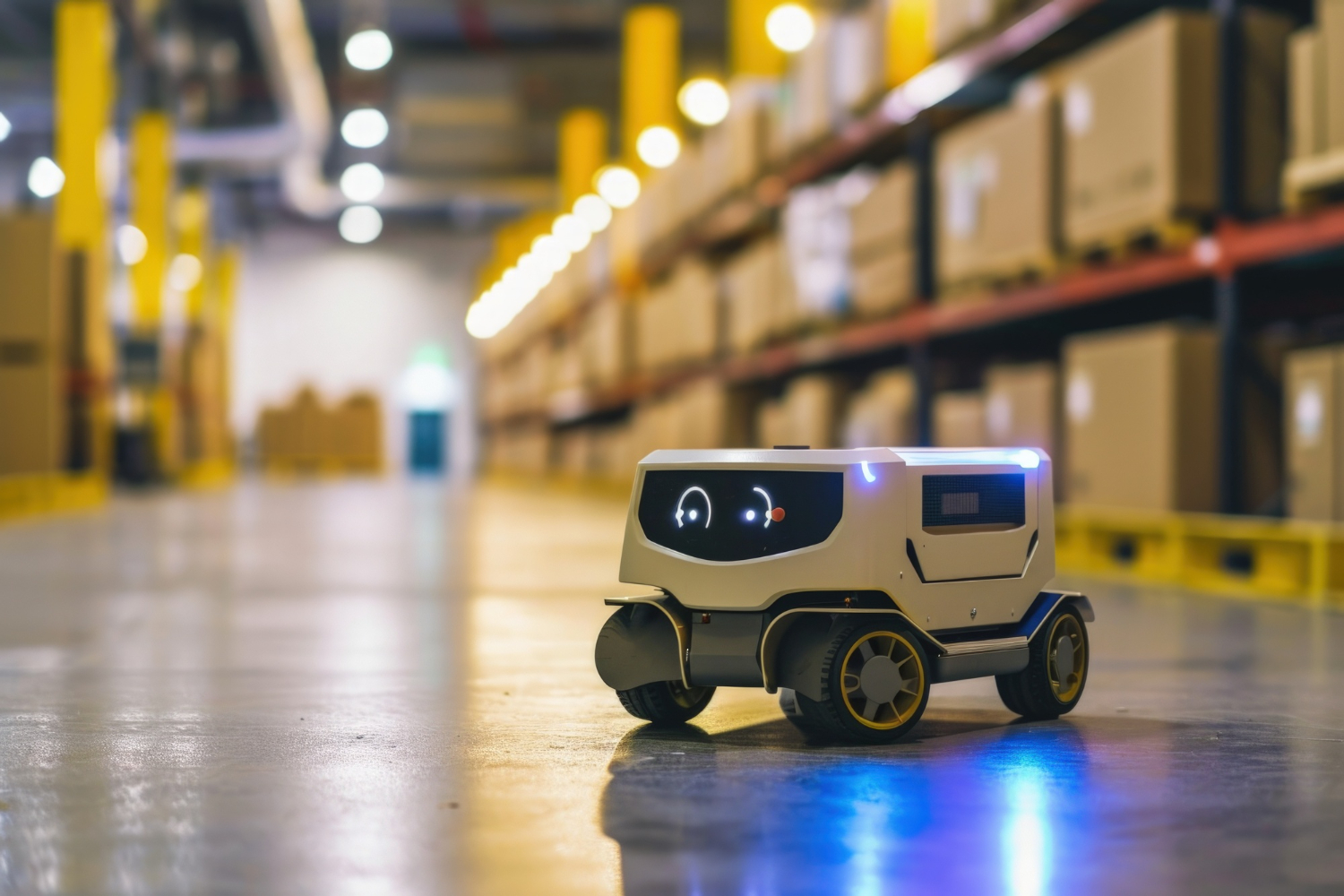
The warehouse floor of 2025 looks nothing like it did a decade ago. Where human workers once walked miles of aisles retrieving orders by hand, fleets of compact, self-navigating machines now move quietly between shelving units, conveyor belts, and loading docks — without a single painted line on the floor to guide them. Autonomous Mobile Robots (AMRs) and Automated Guided Vehicles (AGVs) are no longer experimental technology reserved for deep-pocketed manufacturers. They have become practical, deployable tools that are transforming how logistics, supply chain, and manufacturing operations run, and increasingly, they’re within reach for businesses of all sizes.
Further Reading: Explore related coverage on intelligent automation and robotics at Goldys Robotics — a regularly updated resource for professionals tracking this space.
What Are Autonomous Mobile Robots and Automated Guided Vehicles?
The terms are often used interchangeably, but there are meaningful distinctions.
Automated Guided Vehicles (AGVs) are the older of the two technologies. They follow predetermined routes defined by physical infrastructure — magnetic tape, embedded wires, or reflective markers on the floor. They are reliable and well-understood, but rigid. Change the layout of a facility, and you’re likely changing the routing infrastructure too.
Autonomous Mobile Robots (AMRs) are a newer generation of machines. Instead of following fixed paths, they build and interpret real-time maps of their surroundings using a combination of LiDAR, cameras, ultrasonic sensors, and onboard computing. An AMR can reroute around an obstacle — a forklift, a fallen box, a human colleague — without stopping or requiring manual intervention.
That distinction matters enormously in modern operations where layouts change, order volumes fluctuate, and flexibility is a competitive advantage.
Why Autonomous Mobile Robot Adoption Is Accelerating
Several converging pressures are pushing companies toward robotic automation faster than many anticipated.
Labor availability is the most acute driver
Warehouse and manufacturing work is physically demanding, often shift-based, and in many markets increasingly difficult to staff. According to industry analysts, the logistics sector faces a structural shortfall of qualified workers that manual hiring cannot solve alone. AMRs don’t replace the workforce — but they dramatically extend what a leaner team can accomplish.
E-commerce order volumes continue to climb
Consumer expectations for next-day and same-day delivery require throughput speeds that human-only picking operations struggle to sustain at peak. Robotic systems can run continuous shifts with consistent speed and near-zero error rates on repetitive tasks.
Operational complexity is increasing
Modern distribution centers handle an enormous variety of SKUs, packaging formats, and fulfillment workflows. AMRs can be tasked, re-tasked, and redeployed across these workflows through software, something fixed automation, like conveyors and sorters, cannot easily do.
Intelligent Navigation: How AMRs Share Space Safely with Humans
The safety story around mobile robots has matured significantly. Early concerns about human-robot collision have been addressed through layers of sensor fusion and control logic that would have been computationally prohibitive just a few years ago.
Modern AMRs use simultaneous localization and mapping (SLAM) — a technique that allows a robot to build a map of its environment while tracking its own position within that map, in real time. Combined with machine vision, this means the robot doesn’t just know where it is; it understands and can predict the movement of nearby objects.
Collision avoidance is now standard. Robots slow, stop, and reroute dynamically when a human enters their path. Many platforms integrate with facility-wide fleet management software, so individual robots are coordinating as part of a managed network.
This has made human-robot collaborative workspaces — often called collaborative mobile robotics environments — the dominant deployment model. Rather than isolating robots behind fencing, operators are deploying AMRs that work fluidly alongside human pickers, packers, and material handlers.
Robotics-as-a-Service: Lowering the Barrier to Entry
One of the most significant shifts in how companies access this technology is the rise of Robotics-as-a-Service (RaaS) — a subscription-based commercial model in which businesses lease robotic capacity from a provider rather than purchasing hardware outright.
The implications are substantial. Under a traditional capital expenditure model, deploying a fleet of AMRs required significant upfront investment in hardware, integration, maintenance infrastructure, and internal expertise. RaaS converts that into a predictable operating expense, typically priced per robot per month or per task completed.
For mid-market operators who want to automate but cannot justify a multi-million dollar capital project, RaaS changes the calculation entirely. The provider handles hardware maintenance, software updates, and often integration support. Scaling up — or scaling back — becomes a commercial conversation rather than a capital one.
Cloud connectivity underpins the model. Because AMRs are network-connected and software-driven, a RaaS provider can push updates, monitor performance, and diagnose issues remotely. The robot sitting in a warehouse in Chicago is running software that may have been updated in a data center overnight — an approach borrowed directly from enterprise SaaS.
Real-World Applications Across Industries
AMRs and AGVs are not confined to e-commerce warehouses. The application landscape is broad and growing.
- Manufacturing: AMRs transport raw materials and work-in-progress components between production stations, eliminating the need for fixed conveyor infrastructure and freeing human workers for higher-skill tasks.
- Healthcare: Hospitals are deploying AMRs for the internal logistics of medications, linen, and supplies — reducing staff burden and improving traceability.
- Retail distribution: Large retailers use AMR-enabled goods-to-person systems where robots bring product shelves to stationary human pickers, cutting walking time and increasing picks-per-hour.
- Cold chain logistics: Specialized robotic platforms operate in refrigerated and frozen environments where working conditions are challenging for human workers to sustain over long shifts.
What to Consider Before Deploying Autonomous Mobile Robots or Automated Vehicles
Adopting AMR or AGV technology is not a plug-and-play exercise. Successful deployments share a few common characteristics.
Start with a clear operational problem
The facilities that struggle are those that deploy robots because competitors have. The ones that succeed identify a specific bottleneck — pick rate, material transport time, labor cost per unit — and work backwards to the right robotic solution.
Evaluate integration requirements carefully
AMRs connect to Warehouse Management Systems (WMS) and Enterprise Resource Planning (ERP) platforms, but integration complexity varies considerably by vendor and existing IT infrastructure. The quality of this integration often determines the difference between a system that runs smoothly and one that requires constant manual intervention.
Plan for change management
Workers who understand how the robots work — and why they’ve been introduced — are more likely to collaborate effectively with them. Transparent communication and floor-level training are consistently cited by operations managers as undervalued parts of a successful rollout.
Frequently Asked Questions for Autonomous Mobile Robots and Automated Vehicles
Q: What is the difference between autonomous mobile robots and automated guided vehicles?
AGVs follow fixed, pre-programmed routes defined by physical infrastructure such as magnetic tape or floor markers. AMRs navigate dynamically using sensors, cameras, and onboard mapping software, allowing them to adapt to changing environments and avoid obstacles without human intervention.
Q: Are AMRs safe to use alongside human workers?
Yes — modern autonomous mobile robots are designed specifically for collaborative human-robot environments. They use multi-sensor arrays, machine vision, and real-time mapping to detect and respond to people in their path. Safety certification (such as ISO 3691-4 for industrial trucks) is standard for commercially deployed platforms.
Q: What does Robotics-as-a-Service (RaaS) cost, and is it worth it for smaller operations?
RaaS pricing varies by vendor, robot type, and usage model, but subscription arrangements typically range from a few hundred to a few thousand dollars per robot per month. For smaller operations that cannot absorb large capital expenditures, RaaS can make automation economically viable — especially when factoring in the provider’s responsibility for maintenance and software updates.
Q: How long does it take to deploy autonomous mobile robots?
Deployment timelines depend on facility complexity, the number of robots, and integration requirements. Simple deployments with a small fleet and minimal WMS integration can go live in weeks. Large, complex installations with deep system integration typically take three to six months from contract to full operation.
Q: Will robots replace warehouse workers?
The evidence to date suggests that AMRs most commonly redeploy workers rather than eliminate them. Repetitive, physically intensive tasks are automated while workers shift to roles involving oversight, exception handling, quality control, and higher-skill tasks. In tight labor markets, many operators report that automation allows them to grow throughput without being constrained by hiring capacity.
The Bottom Line
Autonomous Mobile Robots and Automated Guided Vehicles have crossed from emerging technology into proven infrastructure. The logistics, manufacturing, and supply chain sectors are no longer asking whether to automate mobile material handling — they are asking how, at what pace, and on what commercial terms.
The RaaS model has removed the capital barrier that once limited deployment to the largest enterprises. Advances in navigation, sensor technology, and fleet management software have made human-robot collaboration safe, practical, and increasingly normal on the warehouse floor.
For operations leaders evaluating their options, the questions worth asking are increasingly specific: Which workflows create the most friction? Where is labor hardest to retain? What does the integration roadmap look like? The technology has matured enough that the answers drive decisions — not the technology itself.
Further Reading: For more analysis on robotics, automation trends, and the technology reshaping industrial operations, visit the Goldys Robotics section — your resource for staying ahead in an industry that is moving fast.


